68kMLA Classic Interface
This is a version of the 68kMLA forums for viewing on your favorite old mac. Visitors on modern platforms may prefer the main site.
| Click here to select a new forum. | |
| iMac G3 - Bulging Capacitor? C905 on the Power Supply Board v.2 | |
| Posted by: Alex on 2017-10-01 02:46:07 Hi I just need a second opinion and potentially a little help locating a part. I am taking apart an iMac G3, cleaning and inspecting after I found a compromised battery. While going through the process I discovered that the largest capacitor on the Power Supply Board, Ver. 2 appears bulged to the touch and visually. Now, I did try to locate this part and it appears available in bulk which I don't want, I only need one but I was thrown off by the 400wv designation. What does wv mean? Could someone confirm if this is indeed a bulged cap and if you think it is, where can I find one? It reads SMH 470uF 400wv (M) 85°C (location is C905 on the Power Supply Board v.2) Pics of the cap. 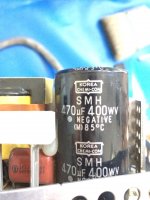 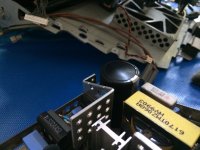 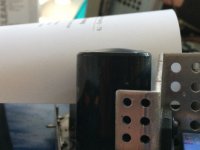 Thanks in advance for your expertise advice. Kind regards —Alex | |
| Posted by: IlikeTech on 2017-10-01 04:50:17 WV means working volts, so you probably want to use a 500 ish volt cap. Try these: http://www.mouser.com/Search/m_ProductDetail.aspx?United-Chemi-Con%2fEKMZ451VSN471MR40S%2f&qs=sGAEpiMZZMsh%252b1woXyUXjyU7r8F9vEKYsDDe%252b4Sy6oE%3d http://www.mouser.com/Search/m_ProductDetail.aspx?United-Chemi-Con%2fEKMZ451VSN471MQ55S%2f&qs=sGAEpiMZZMsh%252b1woXyUXjyU7r8F9vEKYXpdYFqx6Hbs%3d Be sure to check the dimentions of the cap you are replacing. | |
| Posted by: joethezombie on 2017-10-01 05:54:11 I’m not so sure that guy is bulging. Some of the larger caps have a vinyl cover over the top hiding the actual can. Since i see no venting lines, I would imagine that is the case here. if you press down on the top, does it spring back up? | |
| Posted by: Alex on 2017-10-01 08:22:43 Hi joethezombie In fact yes, pressing down on the cap does a little bounce back in return. How could I test the cap to ensure it is working. I am waiting for my first multimeter to arrive. It's a cheapo until I can afford a proper Fluke. Any tips on testing it? Do I have to desolder it to test it? Yes I am truly basic with multimeters. I plan to learn cause it's just so cool to know. Thanks IlikeTech, I appreciate the links. | |
| Posted by: IlikeTech on 2017-10-01 08:54:13 Yes, you do have to desolder it, because you can't test in circuit. Also, the proper capacitance does not mean it is not leaky. No problem for the links! 🙂 | |
| Posted by: joethezombie on 2017-10-01 11:23:10 That big capacitor is probably the very last one that I would suspect as bad. In my experience, it's always the smaller guys that start leaking. If you're not having specific issues with the supply, I personally wouldn't change it out. But IlikeTech is right. To properly test it, you'd have to remove it. And at that point, why not just replace it. | |
| Posted by: Alex on 2017-10-01 12:38:31 Iliketech I am curious, you appear to suggest that a cap can be leaky even if it measures ok. This could mean that caps are leaking without knowing it. With the analog/video boards taken out is there a sort of test to check what might be leaking but not yet detectable. I would think that perhaps putting a piece of paper or a toothpick or some other small probe that could absorb a stain could be one way. I have often heard that bulging is a sign of a failing cap, thanks for the added tip joethezombie. I can't test the entire computer until I get the replacement logic board that I just purchased on eBay. Hopefully it will all be ok. This machine is pretty old now, 1998 or so, I imagine changing caps on machines of this vintage is probably a worthwhile investment. Thoughts? | |
| Posted by: IlikeTech on 2017-10-01 16:10:19 Leaky in multiple ways. They can leak under the cap itself, but they can also leak voltage. I don't know much about that but I know it is a problem with tube equipment. I don't know enough to tell you if it is a problem with this. Chemicon makes good caps, so I'm not sure I would worry about that one. I would, however change caps if I has a problem when you get your new logic board. | |
| 1 |