68kMLA Classic Interface
This is a version of the 68kMLA forums for viewing on your favorite old mac. Visitors on modern platforms may prefer the main site.
| Click here to select a new forum. | |
| IIci model differences? | |
| Posted by: reallyrandy on 2017-07-20 07:08:00 I bought 2 IIcis on CL. They seem to be different though. The nameplates on the front are slightly different as are the main boards. One has metal RAM clips while the other has plastic. There are visible chip differences as well. One front panel name is centered with the Apple logo and the other is flush bottom.  Also, the serials are nowhere to be found on everymac, lowendmac or anywhere else I look. Can anyone shed some light on this?   | |
| Posted by: slomacuser on 2017-07-20 10:37:29 The plastic RAM clips are earlier than metal one, probably just diferent time revision model, one earlier and one later production revision | |
| Posted by: unity on 2017-07-20 11:03:27 They were made only 10 weeks apart form each other and both a couple years into production start. The badging is a stamp of course and If you compare any other models you will see slight variances in location also. The promo photos for the Iici have the badge inline with the bottom of the Apple whereas production is usually like the top one - centered. But you can look online and search images and you will find other lined up with the bottom of the Apple, not centered. I am guessing Apple had some tolerance. Same thing applied to the Iicx, the first design of this case. As for RAM, Apple sourced what it could and from where. Not to mention users often swapped RAM. | |
| Posted by: reallyrandy on 2017-07-20 12:06:27 I'm wondering why the serials aren't being recognized on everymac and lowendmac. hmmm... F10400SJ740 F11438HP724 This one (F10400SJ740 )comes up as a powerbook on everymac. I'm probably gonna make one IIci out of these two, choosing the best parts from both and keep the second one for parts as I need them. That's why I wondered about the differences, Is one better? more rare? etc. Once I get these home I'll photograph them, they're really dirty but I'm gonna clean them both up, maybe recap one if it needs it. 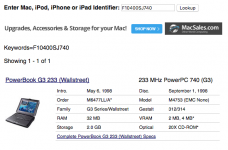 | |
| Posted by: Themk on 2017-07-20 12:50:36 You might try The Pickle's serial number decoder: http://macfaq.org/serial.html | |
| Posted by: Scott Baret on 2017-07-20 16:59:42 Stamps did seem to be changed out periodically, and Apple seemed to be moving to a smaller, lighter version of Apple Garamond on the Macs around 1991. Case in point: SE SuperDrives. All of the writing on a SuperDrive model is smaller than on an FDHD or non-1.4MB SE. | |
Posted by: reallyrandy on 2017-07-20 18:30:37You might try The Pickle's serial number decoder:I just tried. Dates came up but no model info. I emailed him. | |
| Posted by: TheWhiteFalcon on 2017-07-20 19:35:14 That's not what that bar on EveryMac is for...it's for model numbers, like MD101LL/A. | |
| Posted by: unity on 2017-07-20 19:47:44 The model number is on he back of the machine. These do not come up right because they are built-to-order. If they were off the line stock configurations, the last few numbers would be the model number. Im confused as to why this is a big deal? | |
| Posted by: Cory5412 on 2017-07-21 18:57:15 Were there BTO configurations before the beige Power Macintosh G3 in 1997? (Coinciding with when Apple got NeXT and thusly WebObjects, and probably help from PowerComputing, who they also bought and had already set up a BTO store). I haven't really seen anything in any documentation I have about being able to BTO a Mac from Apple - just from VARs, and the process was they bought a stock model and upgraded it to be what you wanted for you. (CompUSA, for example, sold LC IIs pre-upgraded to 10MB of memory.) | |
| Posted by: unity on 2017-07-21 19:00:43 Yes, there were BTO options, they just did not call it that and it was generally catered more to business and education. For example, the IIci could be ordered with a parity chip. Only one board has come across my path with one, but they are out there. | |
| Posted by: Scott Baret on 2017-07-23 00:27:32 There were a lot of less-publicized configuration options on some of the Macs coming out of Apple's factory. The most notable, in my mind, was the stripped-down LC II without a hard drive. Schools were attracted to them because of the low price and ability to run Apple II software, which didn't require a hard drive. We had several of these at the first school I attended. They were used alongside a bunch of Pluses in a lab, so the startup disks and floppy copies of the software were already there. Using RAMDisk+, the system was loaded into memory, the active system disk switched to the RAM disk, and a floppy could be used without any swaps on these machines. (Conveniently, the color file for MECC programs fit alongside the program on a high density disk, as does the Kid Pix sounds file). The stripped LCs were also easy enough to upgrade once we moved on to larger programs; a hard drive could be popped in easily and inexpensively down the line. (We also did the LC III logic board upgrade on some of them). Another great example is the no-CD LC 550. (I think the 575 also was available this way). This is an interesting machine in the fact it has a completely different front bezel, complete with an LC/Classic/SE style groove across the floppy slot. It looks more like a giant LC or Classic from that perspective. These seemed to be an education-only model; I only saw them in schools with one exception: a lady who bought one through her school while working as a secretary. I bought said LC 550 from her a few years ago. It's pretty well stripped down, but I believe she said it cost around $1300 when new. Considering the Trinitron inside, this was a pretty good deal when the LC III's price is considered alongside a Macintosh Color Display. (I really have come to like that particular 550 because of its obscurity and even got it re-capped). I believe the Mac Classic could be ordered with an 80MB hard drive, but don't quote me on that one. I did see one in the wild at one point, but it could have been upgraded very early on in its life cycle. There were dual-drive SE FDHDs out there as well. I would know; I own one, and it did come that way originally. (The original owner actually installed a hard drive on top of the second floppy). I'm curious as to whether there were newer-style LC IIIs available to schools as 25MHz machines at one point. I had one of these and still feel bad about selling it to a guy as an LCIII+ based on the case. I know now to check every III, especially since someone found a 16MHz variety not long ago. | |
Posted by: james_w on 2017-07-30 14:11:48Another great example is the no-CD LC 550. (I think the 575 also was available this way). This is an interesting machine in the fact it has a completely different front bezel, complete with an LC/Classic/SE style groove across the floppy slot. It looks more like a giant LC or Classic from that perspective. These seemed to be an education-only model; I only saw them in schools with one exception: a lady who bought one through her school while working as a secretary. I bought said LC 550 from her a few years ago. It's pretty well stripped down, but I believe she said it cost around $1300 when new. Considering the Trinitron inside, this was a pretty good deal when the LC III's price is considered alongside a Macintosh Color Display. (I really have come to like that particular 550 because of its obscurity and even got it re-capped).I'd love to see photos of the front of this Scott, if you had the time! | |
| 1 |