68kMLA Classic Interface
This is a version of the 68kMLA forums for viewing on your favorite old mac. Visitors on modern platforms may prefer the main site.
| Click here to select a new forum. | |
| Yet another Mac Classic PRAM battery leakage | |
| Posted by: Carpallo on 2017-01-16 05:27:24 Hi everyone: I bought some years ago a Mac Classic and I was unaware of the problem of the PRAM battery. At the beggining it worked fine but one day I powered it up and... ooops, it didn't boot up any more. I opened it and found that the damn PRAM battery has went off and the acid had disolved the battery holder and spreaded across the board. The other day I discovered this forum and read a topic of GnatGoSplat, https://68kmla.org/forums/index.php?/topic/17191-mac-classic-pram-battery-carnage/, where he could repair a damaged board so I would like to know if someone can give some suggestions. I should have taken a photograph before cleaning the acid, but it is more or less the area that was covered by the acid: /monthly_01_2017/post-8002-0-08626900-1484572839.jpg"> 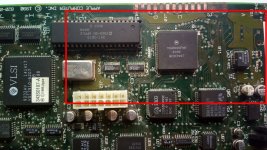 These are another pictures of the tracks and vias: /monthly_01_2017/post-8002-0-26696700-1484572985.jpeg"> 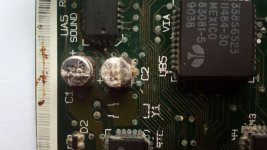 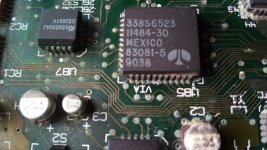 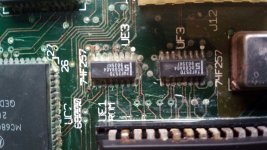 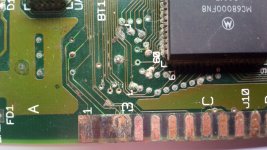 And this is a picture of the board as it is: /monthly_01_2017/post-8002-0-44994500-1484573036.jpeg"> 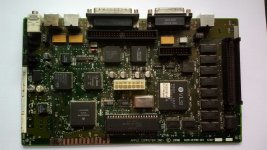 I have seen in a video that some people put the board into the dishwasher, do you think that it could dissolve the corrosion that is underneath the chips and on the vias? Any help is welcome. Thanks in advance!!!! | |
| Posted by: Johnnya101 on 2017-01-16 05:30:47 All I can say is that you need to wash and recap that thing NOW!!! | |
| Posted by: Carpallo on 2017-01-16 05:52:51 You mean wash it in the dishwasher? I have bought some capacitors in ebay but they should arrive in a month... Thanks for your piece of advice!!! | |
| Posted by: bibilit on 2017-01-16 06:13:05 Don't waste your time and money, this board is dead, it will require a lot of job done and probably won't work again. Find yourself another board, sorry to say that but very few boards have survived from that nightmare. | |
| Posted by: Carpallo on 2017-01-16 06:21:10 Yeah, I know that you are right. I bought later another Mac Classic and the first thing I did was removing the battery... It is just that I am a nostalgic and regret to throw it away. Thank you anyway | |
| Posted by: bibilit on 2017-01-16 06:42:02 I you want to spend a couple of hours, and try to revive it is ok. i have one like yours, already spent too much time and could not make it work so far. | |
| Posted by: Carpallo on 2017-01-16 06:44:30 Well, if the board is dead a washing wouldn't make it any harm and the caps cost just one buck, so... I can give it a try!!! | |
| Posted by: IlikeTech on 2017-01-16 10:33:20 It doesn't look as bad as some on here, so why not give it a go? You will need to throughly clean the board, replace the caps, and jumper any broken traces. Good luck! IlikeTech | |
| Posted by: Johnnya101 on 2017-01-16 11:29:14 Yeah it doesn't look dead just absolutely filled with gunk. Well, not dead YET. That stuff will rot through the board soon... try and do everything quick! At least wash it! | |
| Posted by: Carpallo on 2017-01-16 11:42:53 Sorry, I am a newbie... when you say that I should wash it, do you mean in the dishwasher? Otherwise I would not be able to clean it without desoldering the chips, because the acid is underneath and around the leads of the chips. | |
| Posted by: IlikeTech on 2017-01-16 12:48:35 I think in the dishwasher? I'm not quite sure. | |
| Posted by: Compgeke on 2017-01-16 19:04:34 Not trying to discourage you, but I'd consider this board a goner myself. If you really want to try, go for it but I can already see quite a few damaged traces on the surface and these are multi-layer boards. Also looks like someone's scratched at that board with a screw driver or something in between UE3 and UF3. Dish washer can be tried but I'm not sure how much good it'll do. You'll want something to dissolve the acid and see what that turns up. | |
| Posted by: just.in.time on 2017-01-16 19:54:50 You can't wash away corrosion. That is a chemical reaction that has changed the properties of the metal. Much like you can't untoast bread that has already been toasted. That said, remove all the old capacitors, wash, test the continuity of all vias to and from the capacitor pad locations. Patch as necessary. Recap the board. Continue to test continuity from every pin to the next as per schematics. That's the theory of how you would do it. In practice, I'm not sure. I can barely solder 😀 It should be theoretically possible to make the board work again. That said, with the damage present I expect you will have dozens if not over a hundred patch wires going all over the place. I honestly think you should give it a go 🙂 like you said, it's already dead so you can't break it any further. More likely what will happen is it will become a great source of practice to help you work on your next system. I myself need to do some practice to repair a board of my own. | |
| Posted by: Carpallo on 2017-01-17 03:11:31 Thank you all for your advices and suggestions. My cousin told me yesterday that I could use 3 in 1 oil to remove the acid around the chip leads and it has worked a little bit. It looks better now. I know that trying to make this board work again is a craziness and I will need a good bunch of wires to patch the tracks and vias, apart from the time, of course... One one the SMD 74F257D (UE3) has even lost two of its leads and I will have to take it to an electronic technician that I know (quite cheap, in fact) because I am not able to solder SMD chips... I am quite stubborn though, so I will give it a go and make you know if I finally achieve it. Thanks a lot again for your help!!! 😉 | |
| Posted by: IlikeTech on 2017-01-17 04:48:22 I wish you luck! | |
| Posted by: Carpallo on 2017-01-17 05:46:29 Thank you, I need it! 😉 🙂 | |
| Posted by: techknight on 2017-01-18 15:55:19 That board is gone. I am looking at the photos full screen, there are dozens upon dozens of VIAs where the copper annular rings were eaten away. Easier way to tell is shine a flashlight through it from the bottom. if you see light around the via, and the trace is opaque, Its toast. | |
| Posted by: Carpallo on 2017-01-24 13:58:23 Ouch, thank you Techknight I will try to use the flashlight. Surely you are right and the board is dead... | |
| Posted by: Carpallo on 2017-01-26 06:19:00 I have used the flashlight and no more than 7 or 8 vias are completely dead (quite enough). I can see the light passing through. May be I can use a needle to join the two sides together... or perhaps it is another crazy idea. Thanks anyway!!! On purpose, the image of the board iluminated from the bottom is awesome!!! 😉 | |
| 1 |