68kMLA Classic Interface
This is a version of the 68kMLA forums for viewing on your favorite old mac. Visitors on modern platforms may prefer the main site.
| Click here to select a new forum. | |
| Mac SE Clock Drift | |
| Posted by: Iesca on 2025-11-05 06:25:46 I just installed a CR2032 in a Mac SE, and while it's keeping most of its PRAM settings (including the date), the clock drifts significantly when the machine is off. Anything I should know, or is this a sign of a bigger issue? | |
Posted by: David Cook on 2025-11-05 07:22:57the clock drifts significantly Can you be more specific? I've seen this happen on a couple of Macintosh IIsi computers that I ultrasonically cleaned. The root cause was the crystal was damaged. However, it was cheap and easy to replace. | |
| Posted by: Iesca on 2025-11-05 07:48:56 I will set the time, turn off the machine, turn it on again later, and the clock will be the wrong time, behind by several hours or more. | |
| Posted by: David Cook on 2025-11-05 08:15:47 Assuming the battery is good, then I suspect the crystal. That is Y1 right next to the RTC (real-time clock) 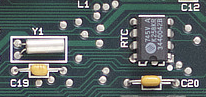 | |
Posted by: joevt on 2025-11-05 14:25:27I will set the time, turn off the machine, turn it on again later, and the clock will be the wrong time, behind by several hours or more.Is there a relation between the amount of time the machine is off, and the amount of time that the clock is behind by? Is the amount of time that the clock is behind by at least less than the amount of time the machine was off? Assuming the battery is good, then I suspect the crystal. That is Y1 right next to the RTC (real-time clock)Wouldn't a bad crystal also affect the time while the computer is on? What voltage does the RTC and crystal have when the computer is off? What voltage does the RTC and crystal have when the computer is on? | |
Posted by: David Cook on 2025-11-05 15:51:04Wouldn't a bad crystal also affect the time while the computer is on? When the computer is turned on, the clock is kept in a low memory global which is advanced by the interrupt timer. Then, it is written back to the clock chip at shutdown. | |
| Posted by: Iesca on 2025-11-06 11:32:48 I will start with swapping the clock crystal out with one from a Plus (I assume they are the same rate) and see how that goes. The clock stays in time while on, but after an evening of being off or longer, it's maybe 12 hours behind, somewhere around there, I haven't measured exactly. | |
| Posted by: cheesestraws on 2025-11-06 11:38:44 Yes, sounds like perhaps the oscillator is damaged. The CPU is responsible for keeping time while the machine is on. | |
| Posted by: Iesca on 2025-11-06 11:40:40 I will start with swapping the clock crystal with one from a Plus (I assume they are the same rate) and see how that goes. The clock stays in time while on, but after an evening of being off or longer, it's maybe 12 hours behind, somewhere around there, I haven't measured exactly. I assume that a normal 3v CR2032 is adequate in terms of voltage? | |
| Posted by: Iesca on 2025-11-06 15:12:51 Whoops sorry about the doublepost, was having internet connections issues | |
Posted by: joshc on 2025-11-06 15:32:43a normal 3v CR2032 is adequateYes | |
| Posted by: Iesca on 2025-11-06 16:54:01 Sadly, swapping the crystal does not seem to have helped. The clock basically stopped progressing while it was off it would seem. I suppose next I'll try swapping the RTC ship, unless someone has another suggestion. I'll also check traces around the area. | |
| Posted by: David Cook on 2025-11-06 17:03:33 Yes -- check the traces. Do you have an oscilloscope? If not, the handheld ones are reasonably inexpensive: | |
Posted by: nathall on 2025-11-07 20:09:54When the computer is turned on, the clock is kept in a low memory global which is advanced by the interrupt timer. Then, it is written back to the clock chip at shutdown. Without the intent to derail lesca’s thread, what sort of failure would cause the inverse condition? Meaning, perfect time is kept while the machine is off but the clock is frozen while the machine is on? | |
Posted by: superjer2000 on 2025-11-08 12:09:50Without the intent to derail lesca’s thread, what sort of failure would cause the inverse condition? Meaning, perfect time is kept while the machine is off but the clock is frozen while the machine is on?I'm a bit confused here also. I'm understanding the responses from @cheesestraws and @David Cook as indicating that the crystal has no bearing on time keeping when the computer is on. That is different than my experience (on the Macintosh Classic) (https://68kmla.org/bb/index.php?thr...r-needs-to-be-jump-started.35352/#post-382220). In that case, I had a Mac where the clock would not increment (when the computer was on) unless the crystal was essentially jump started. I don't recall if I ever got back to finalizing a repair on that machine - I bought some flux cleaner thinking that maybe some residual flux was messing with the oscillator circuit capacitance but I don't think I never followed through. | |
Posted by: David Cook on 2025-11-08 16:06:22I'm a bit confused here also. I'm understanding the responses from @cheesestraws and @David Cook as indicating that the crystal has no bearing on time keeping when the computer is on. Hi @superjer2000, My actual quote was a little more general: "When the computer is turned on, the clock is kept in a low memory global which is advanced by the interrupt timer." Depending on the Mac hardware, that interrupt timer may be generated by a number of different sources. The Mac Classic has significantly redesigned hardware. Perhaps the interrupt is generated by the RTC/crystal on the Mac Classic? If that's what you're seeing -- then that makes sense. For that example on a Mac Classic, perhaps a broken trace between the RTC and a VIA (or similar chip) is preventing the interrupt and thus the clock stops advancing when running. But, otherwise, the RTC may be running fine and sends an updated time when the computer first asks for it when first turned on. (If the time doesn't advance when turned on, that non-advanced time will be written back to the RTC on shutdown.) In otherwords, maybe the communication lines and crystal are working, just not the interrupt line. - David | |
| Posted by: Iesca on 2025-11-08 16:26:18 Please derail! I won't be able to experiment with my original dilemma for a few days at least. | |
Posted by: superjer2000 on 2025-11-08 17:44:14Hi @superjer2000,Thanks @David Cook. I was reading your response in the context of what you had quoted ("Wouldn't a bad crystal also affect the time while the computer is on?") to mean that, generally no, a bad crystal would not affect the time when the computer is on. I may have misunderstood, and I am still not clear on whether this is the case or not. If, for example, the ~32khz crystal from the computer we're talking about here (Macintosh SE) was removed from the motherboard completely, would the clock (i.e. the clock in the menu bar, or General CDEV) still advance after the computer boots? I've been trying to Google an answer here without success. | |
| Posted by: Iesca on 2025-11-10 13:10:55 Well, this is embarrassing. Seems I had installed a dead battery! Not sure how it was keeping any settings at all with <1v, but I went through my stock and found that a few had gone flat. Found one with a little under 3.2v output, and it now seems to be keeping time when off. I will check one more time leaving it off overnight, but that seems to have been all that was wrong. D'oh! | |
Posted by: David Cook on 2025-11-10 16:25:32Well, this is embarrassing. Seems I had installed a dead battery! Not sure how it was keeping any settings at all with <1v, but I went through my stock and found that a few had gone flat. Found one with a little under 3.2v output, and it now seems to be keeping time when off. Glad you figured it out and posted the solution. We all have been there. | |
| 1 |