68kMLA Classic Interface
This is a version of the 68kMLA forums for viewing on your favorite old mac. Visitors on modern platforms may prefer the main site.
| Click here to select a new forum. | |
| IIfx 16 MB Composite SIMM, Temperature, Power Usage, and Tinning | |
| Posted by: David Cook on 2025-07-20 12:55:48 I recently purchased a Macintosh IIfx that came with an unusually large amount of RAM: 80 MB. The RAM is in the form of 4 x 16 MB SIMM (64 MB bank A) and 4 x 4 MB SIMMs (16 MB bank B). 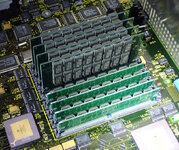 The 16 MB SIMMs are composite; each one consisting of 4 rows of 4 MB of RAM per SIMM. I have never seem composite IIfx SIMMs before. 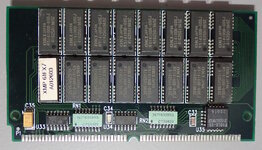 The chips seem to have 1993-1994 date codes. Someone paid a lot for these at the time. 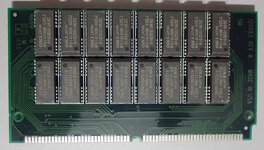 The RAM felt really hot when I removed the board for recapping. A large 5 1/4 hard drive was running directly above them, and the lid on the IIfx was off (thus the power supply fan was not producing much of a flow over the RAM). 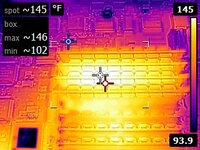 I decided to test the power usage and temperature. Test conditions:
After a cold boot and running a full memory test, the 16 MB composite SIMMs measured 127 F. Surprisingly, the 4 MB SIMMs seemed to run a little hotter, around 132 F.  When I switched to modern recreation 16 MB SIMMs, the modern SIMMs ran much cooler at 113 F. 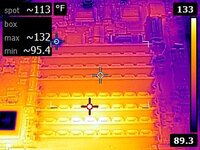 Current Measurements  The total current used by the Macintosh IIfx (@ 120 V AC) with composite 16 MB SIMMs + 4 MB SIMMs. 0.79 A during cold-start memory test = 95 watts 0.61 A when booting 0.65 A when idle in Finder = 78 watts 0.70 A during MacTest Pro memory test The total current used by the Macintosh IIfx (@ 120 V AC) with modern 16 MB SIMMs + 4 MB SIMMs. 0.63 during cold-start memory test = 76 watts 0.56 when booting 0.59 when idle in Finder = 71 watts 0.61 during MacTest Pro memory test Just for the fun of it, I installed two sets of modern 16 MB SIMMs for a total of 128 MB. 0.59 when idle in Finder = 71 watts From this, I conclude that the composite 16 MB SIMMs do indeed use a lot more power than their contemporary 4 MB counterparts. The larger PCB surface area acts like a heatsink, thus they stayed cooler (albeit no hard drive running) during a 10 minute test compared to the 4 MB SIMMs despite the increased power consumption. The Macintosh IIfx uses the most power when first starting up during the ROM’s memory test. Power usage varies slightly from booting to idle, but it seems like the more memory is accessed, the more power is used. SIMM Socket Contact Issues I ran into issues with the modern SIMMs I purchased. Some worked perfectly, some needed to be reinserted into the SIMMs sockets and wiggled, and some just never worked. To make matters worse, the IIfx does not produce the tones of death for bad SIMMs in bank A. It will just sit there and not proceed to enable the graphics card. If you are working on bad traces on a IIfx, you can't tell if you've got a bad motherboard or if the SIMMs are loose. Even if you know the IIfx is good, since so much memory takes time to check, you aren’t sure if it is still checking bank A or if it is stuck. However, if you watch the power usage, it dips down when the IIfx is stuck, and stays high if it is actively checking memory. Nice trick to remember in future diagnostics. To fix the SIMMs, I coated the SIMM contacts (fingers?) with solder. This is a trick other people use when the PCB is too thin (usually for SE/30 replacement ROMs). I removed any bridges and large bumps of solder with solder wick. This results in the contacts having a thicker and softer surface to mate firmly with the SIMM socket pins. In fact, I got all of the problematic RAM SIMMs working and fully tested using this technique. Therefore, the chips and PCB traces were fine -- it was the contact that was the problem. 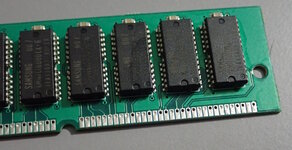 As the SIMM sockets and motherboard age, I think they become more finicky. On a machine that has run hot for years, I could even believe the contacts points migrated slightly in the plastic as they pressed against whatever particularly-shaped SIMMs were installed at the time. Looking at my stock of original IIfx SIMMs, I notice all the non-gold-plated SIMMs seem to have either solder or thick tinning (from the factory?). Check out a close-up of the composite SIMMs. That sure looks like the manufacturer coated them with light solder. 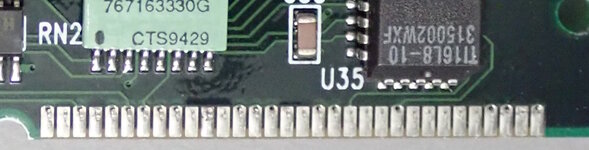 In conclusion: * Composite SIMMs use more power * Composite SIMMs run hotter due to power usage and being near the hard drive * Modern 16 MB SIMMs are a better choice due to lower power usage * The IIfx uses the most power during cold-start and heavy memory access -- at least in my set of tests * The IIfx doesn't produce death chimes for loose SIMMs in bank A. It just sits there. * Solder on the SIMM fingers can fix contact problems - David | |
| Posted by: ObeyDaleks on 2025-07-20 13:58:17 I experienced the same thing with my 16MB “Doug Brown SIMMs”. I added solder to the pads, same as you did, and now they snap in nice and tight and work flawlessly. The key is to tin them all to the same thickness which is more tricky than it might seem. I use Kapton tape on the back side to prevent solder from bleeding through those tiny holes. | |
| Posted by: ObeyDaleks on 2025-07-20 14:06:36 By the way, from my recollection, IIfx will not give you a sad chime if the RAM is missing or “undetected” but it generally chimes for bad RAM. It sometimes takes a very long time, like up to a minute after happy chime. | |
Posted by: David Cook on 2025-07-20 14:50:11IIfx will not give you a sad chime if the RAM is missing or “undetected” but it generally chimes for bad RAM. It sometimes takes a very long time, like up to a minute after happy chime. Yes, it definitely gives a sad chime for bad or loose RAM in bank B. In fact, for loose RAM in bank B, it let's you know immediately. And yet, for loose RAM in bank A, it does not. Maybe you're right that it assumes bank A is empty and just stops. | |
| Posted by: olePigeon on 2025-08-01 14:29:24 I have similar SIMMs in my IIci. 4 banks of 4 MBs (2 banks per side like in your picture) for a single 16MB SIMM. I have all 8 SIMM slots filled with them. I call it the Brick o' RAM. They're hilariously big. I love 'em. 😀 | |
| 1 |