68kMLA Classic Interface
This is a version of the 68kMLA forums for viewing on your favorite old mac. Visitors on modern platforms may prefer the main site.
| Click here to select a new forum. | |
| Macintosh II A/UX for MC68851 | |
| Posted by: David Cook on 2024-04-15 12:46:36 Sometimes I pay too much for a machine just to solve some mysteries. Recently, a Macintosh II with a hard drive labeled A/UX came up for auction. 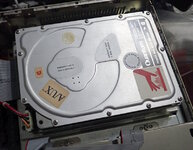 The seller did not show photographs underneath the tray, so I was taking a chance on the motherboard being undamaged and having its socketed chips in place. My prediction was that this Macintosh would have the 68851 PMMU and 68881 FPU, as they are required to run A/UX. The 68851 is particularly difficult to find, and was the primary reason I wanted this computer. Two other stickers on the front of the case caught my eye. 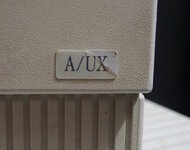 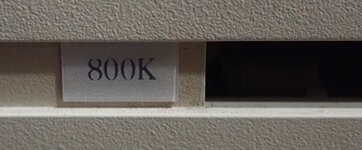 The 800K sticker suggests that this Macintosh II also has the newer ROMs and SWIM, as the sticker came with the 1440K floppy drive upgrade. Indeed. Here is the 800K drive, with two detection switches. 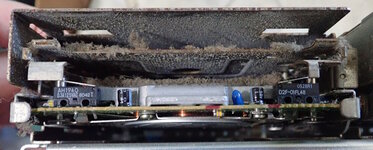 And the 1440K upgrade on the right, with three detection switches. Neither drive works, as they need serious cleaning and relubrication. 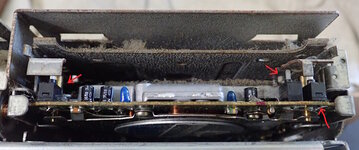 Of course, the ROMs have been upgraded. I was initially confused by the letter 'B' and the letter 'C' on the ROMs. I thought maybe only half of the ROMs were upgraded. But, the '342-0639' through '342-0642' portion of the part number is the important indicator. I believe the 'B' and 'C' are just vendor codes for the PROM. Anyway, the point is, when you look up your Macintosh II ROM codes on the internet, don't worry about the final letter. 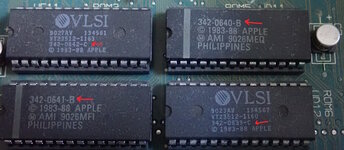 How about the 68851 and 68881? Yes! 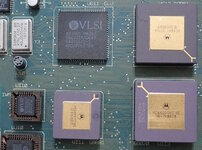 So, this is a fully upgraded Macintosh II. Even the video card has upgraded socketed VRAM to make it 8-bit. I wonder how much system memory this Mac has? It must be chock full. Hmm. These look suspiciously like 256K SIMMs. 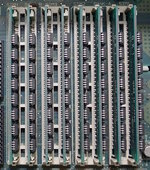 Short-height SIMMs with 18-pin PLCC with pins on all four sides are almost always 256K. The part number confirms it. 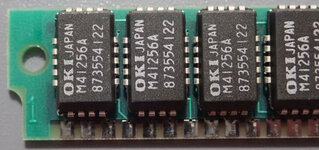 For all of its upgrades, this Macintosh only has 2MB of RAM. The RAM date code is the 35th week of 1987. All the other part numbers on the computer are six months to nearly a year later. I doubt Apple's supply chain would have memory SIMMs sitting around for a year. I suspect that the original memory was swapped out at some point. Yet, InfoWorld describes a 2MB configuration for A/UX. So, maybe this is original. 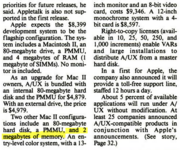 "Your (M5031), with serial number F8336APM5031, was the 7299th manufactured during the 33d week (August 15) of 1988 in Fremont, CA." Most of my Macintosh II computers have a M5000 ending. Is M5031 an A/UX configuration? 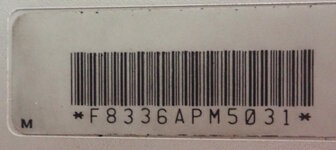 The machine was dustier than most. There's even dust under the reset switch. 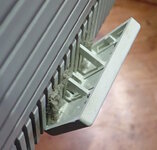 Corrosion At first glance, the capacitor-juice corrosion seems significant. Surprisingly, this turned out to be a reaction with the solder mask more than the traces. The solder mask on this Macintosh is really thick. It is more like a plastic sheet than a coating. 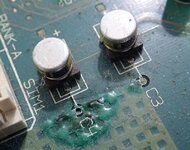 The traces to the power switch are almost always broken in the Macintosh II / IIx series. But, on this computer, the traces are perfect. In fact, no traces are broken on this board. 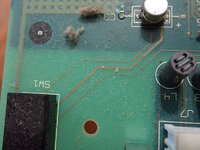 I have long suspected that the power trace damage is caused by a battery voltage present on these lines when capacitor fluid leaks. One of the batteries on had been clipped off, which probably saved the traces on this motherboard. 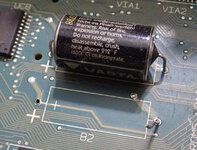 Intrusion Alarm That brings us to the final auction mystery. In the posted images, there was a small white object with wires connected to the metal shielding of the case. Was it an alarm installed by the university to alert them when someone opened the computer???? 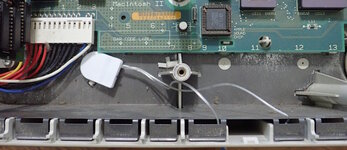 Ha. Nothing is ever that dramatic. It's a lame C2032 coin cell holder that replaced the clipped battery. It must have fallen off at some point. 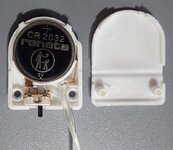 Amusingly, the battery warning symbol universally conveys its meaning pretty clearly. It's not a Susan Kare, but pretty close to her level.  What about A/UX? I didn't grow up with Unix systems, and I knew this shipped with the weak A/UX 1.0, so I didn't really care about owning A/UX. Still, it would have been novel. Unfortunately, the drive had been wiped and replaced with System 6.0.7 (circa 1990). Also sadly, the drive is nearly dead. It took 5 reboots to get it to spin up. I was able to copy much of the contents (including some Think C 4 personal projects). However, there were many files with bad blocks. In the end, this was a very interesting machine to clean up and explore. - David | |
Posted by: CompactManiac on 2024-04-15 13:42:17How about the 68851Many years ago I attempted to get a 68851 MMU working with an Orion 68020 accelerator I had bought for an SE. The accelerator board had a socket for the MMU so I ordered one from MacLine around 1992 and fitted it. At the time I was using Mode32 and System 7 with the software for the accelerator also present but could not get the SE to support virtual memory no matter what I tried. I suspect this accelerator was a little ahead of its time as it had come out about 3 years before System 7 was released and its possible it needed a further patch for the accelerator even though the guide suggested it was possible to use Virtual memory. So in the end I returned the 68851 chip to MacLine for a full refund. It was scary stuff pulling that chip out as it has so many pins and then having to wait about 2 weeks for them to verify it still worked when they retested it in a Mac II! | |
Posted by: Phipli on 2024-04-15 14:48:27Many years ago I attempted to get a 68851 MMU working with an Orion 68020 accelerator I had bought for an SE. The accelerator board had a socket for the MMU so I ordered one from MacLine around 1992 and fitted it. At the time I was using Mode32 and System 7 with the software for the accelerator also present but could not get the SE to support virtual memory no matter what I tried. I suspect this accelerator was a little ahead of its time as it had come out about 3 years before System 7 was released and its possible it needed a further patch for the accelerator even though the guide suggested it was possible to use Virtual memory. So in the end I returned the 68851 chip to MacLine for a full refund. It was scary stuff pulling that chip out as it has so many pins and then having to wait about 2 weeks for them to verify it still worked when they retested it in a Mac II!Did you install the Compact Virtual control panel? System 7's built in Virtual Memory doesn't recognise the SE even with an upgrade card, that I know. I didn't think MODE32 would work on an SE even with a CPU upgrade - I thought it patched the Mac II ROM? | |
Posted by: CompactManiac on 2024-04-15 15:00:20Did you install the Compact Virtual control panel?No I was unaware it was needed at the time. It mentions here https://www.micromac.com/products/compact_virtual.html that Compact Virtual would work with older Compact Macs that had a 68030 processor that includes the PMMU. It doesn't specifically mention it also supports older Macs using a 68020 + separate 68851. If it did then this may still have worked! | |
Posted by: Phipli on 2024-04-15 15:07:10It doesn't specifically mention it also supports older Macs using a 68020 + separate 68851It says it works with 020+68851 on the page I linked to. But also I've seen 020 cards in the installer. I can't remember if that includes yours. I have a photo of the applicable part of the installer somewhere. | |
| Posted by: Phipli on 2024-04-15 15:17:35 I found an old (as in one I took previously) photo - I can't see a MacPeak option, but that doesn't mean it wouldn't at least partially work. 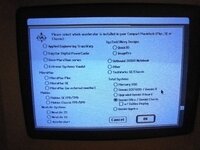 There is an "Other" option. It might make it difficult to add 16MB of RAM, but perhaps virtual memory works. Plus there is another trick to extend RAM in some instances. Also, worth making sure none of those cards are a clone of yours. | |
| Posted by: MOS8_030 on 2024-04-15 16:26:46 Cool find! $9346 in today's dollars is an eye-popping $24,675. For 16mhz! Interesting that the 851 is "XC". It's a early part and means it wasn't fully qualified at the time it was released. | |
Posted by: CompactManiac on 2024-04-16 00:52:39I can't see a MacPeak option, but that doesn't mean it wouldn't at least partially work.This is very interesting and also the first time I saw the options inside Compact Virtual. I never realised it was so specific to individual accelerators. There were lots of different accelerators out there but also a lot of rebadging of the same old ones at times with just a higher clock speed. The MacPeak Systems Orion accelerator did get taken over by Irwin at some point and that's where the water gets muddy. It's certainly possible some combination of option inside Compact Virtual + Orion/Irwin software might have worked - the Orion guide gave no clues. At the time I rang MacLine to ask for advice. They did not suggest trying Compact Virtual so I decided to call it a day at that point since Compact Virtual would have been even more expense. I was always curious though if it would have worked. | |
Posted by: Phipli on 2024-04-16 01:04:09I never realised it was so specific to individual acceleratorsIt's because the extra memory can be in different places in the address map, they do various ROM hacks, plus virtual needs to know if there is any extra devices like ethernet or video cards in the address space, so that it juggles them about correctly. It's most important for cards with a built in second function I suppose. The more messy trick was that some cards' drivers create a RAM disk with any extra RAM you fit. You can use compact virtual with this by putting the scratch file on the RAM disk. This will work with any card that puts a RAM disk on the desktop, including some video cards and other NuBus cards in a Mac II family machine | |
| Posted by: Arbee on 2024-04-16 07:27:22 The letter suffix is usually a mask revision on Apple parts. And for ROMs in particular, it often is interchangeable with a version code (it definitely is on the Plus and some Apple II stuff, for instance). | |
| Posted by: joshc on 2024-04-16 07:28:43 Another excellent write-up and documentation of a piece of history that would most likely otherwise be lost to time. Thank you! I hadn’t seen those A/UX specific model stickers before. | |
| 1 |