68kMLA Classic Interface
This is a version of the 68kMLA forums for viewing on your favorite old mac. Visitors on modern platforms may prefer the main site.
| Click here to select a new forum. | |
| Lisa PCB Silkscreen Font | |
| Posted by: AlexTheCat123 on 2022-08-30 17:11:25 Hi guys! I asked this same question on LisaList2 yesterday, but I figured I'd post it here too in case anybody can help. I've been working on replicas of a bunch of Lisa PCBs lately and so far I've been able to get everything really accurate to the originals, with the exception of one thing: the silkscreen font. I've taken some pictures of the text and ran them through those websites that identify fonts from images, but I can't find anything that's a perfect match. The closest thing I've been able to find is the Monaco font, which I've used on all of my boards so far, but it's still not even close to identical. Now that I'm working on doing the I/O board, which has way more text on it than the other PCBs that I've done, it would be really nice to find the exact font that Apple used. Does anybody know what that font is? The same font is also used on Macintosh boards from the same time period in case that helps. Thanks! Alex | |
| Posted by: joshc on 2022-09-01 20:07:22 Can you post some photos of the boards you're trying to replicate? I'm not a font expert by any means but we definitely have a few people here who might be able to identify them. | |
| Posted by: mg.man on 2022-09-03 01:45:46 Not the greatest photo, but have this one handy... 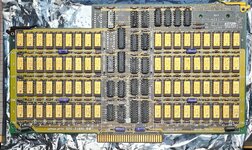 I believe @AlexTheCat123 is after the font used for Row/Column & component names?? | |
| Posted by: Trash80toHP_Mini on 2022-09-03 08:46:43 Have you asked around for the PCB design software used to create the boards? That's a monospace face that might be standardized in that particular package? More likely it's the standard face used in the interpreter phase of PCB production. I'd think TXT would most likely be defined in ASCII code in the Gerbers exported? Input from someone familiar with the formatting of Gerber files would be helpful here. A table of characters used in that format would be most helpful. @max1zzz or @Bolle is this the face that pops up at the production end of your Gerbers? That would be too easy. 🙂 A typeface used for screen display in text editors of the era would most likely be the source. The face would likely have been tweaked for clarity in the screen printing process as opposed to clarity of raster imaging on a terminal I'd think? Fairly high resolution images of every character you can find on the boards for use as templates in Fontographer would be your backup plan. The only PITA there would be boxed production run/date characters, which would be a very limited subset. Can't imagine the need for lower case or more special character than the 128 printable characters defined in ASCII. Subtracting lower case you'd be down to 102 characters which might be reduced to a lower number in Gerber formatting? IOW, not really a biggie if you can't find it. 😉 edit: look thru old teletype fonts for sans serif faces. The only serifs in the photo above would be on "1" for differentiation from "I" and the scrunching employed in the the wide characters M and W would be tells to look for after weight of characters. | |
| Posted by: mg.man on 2022-09-03 10:06:11 There's a parallel discussion over on ... The consensus is it's likely from the CAD package Apple used. It would not surprise me if Apple had something custom created. I'm also wondering if it's a 'vector' vs. 'raster' font. Does Fontographer support vector fonts? | |
Posted by: Phipli on 2022-09-03 10:39:11There's a parallel discussion over on ...Fontographer works with vector fonts, but not sure about specific formats. Most common font formats were developed after the Lisa's development. | |
| Posted by: Trash80toHP_Mini on 2022-09-03 16:43:36 Digitized type in IK format of Ikarus/URW software was the pre-Lisa digital type standard. | |
| Posted by: AlexTheCat123 on 2022-09-03 17:25:56 Thanks for all of the suggestions guys! If we're not able to find the original font from Apple's CAD package, I'll definitely look into the Fontographer thing. I hadn't considered recreating the font using the original text as a template, so thanks for giving me that idea if all else fails! | |
Posted by: Phipli on 2022-09-04 01:27:26Thanks for all of the suggestions guys! If we're not able to find the original font from Apple's CAD package, I'll definitely look into the Fontographer thing. I hadn't considered recreating the font using the original text as a template, so thanks for giving me that idea if all else fails!Have you tried some font identification websites? Where you upload an image and it (apparently) tells you the font? | |
| Posted by: cheesestraws on 2022-09-04 03:58:06 I looked into this for other reasons—not the Lisa fonts, other PCB fonts—a while back, and yeah it's probably something built into the CAD software. A lot of the fonts from these don't seem to have been converted to modern outline fonts, partly because you have to muck about with them to get them to work: I believe (but please don't quote me on this, both my CAD and Font-fu are weak) because those fonts tend to be encoded as zero-width line segments and few people want them for their æsthetic value, so it's not worth the extra effort. Have you tried some font identification websites? Where you upload an image and it (apparently) tells you the font? I've taken some pictures of the text and ran them through those websites that identify fonts from images guessin' the answer here is yes ;-) | |
| Posted by: Phipli on 2022-09-04 04:34:27 Ah, sorry, I did re-read to check if you had said but was skim-reading and missed it. | |
| Posted by: Trash80toHP_Mini on 2022-09-04 04:57:46 I wonder if Silk Screen Layer production was done by the art department rather as part of the PCB CAD package? That would be a lot easier and far more flexible than any other process in that time frame. 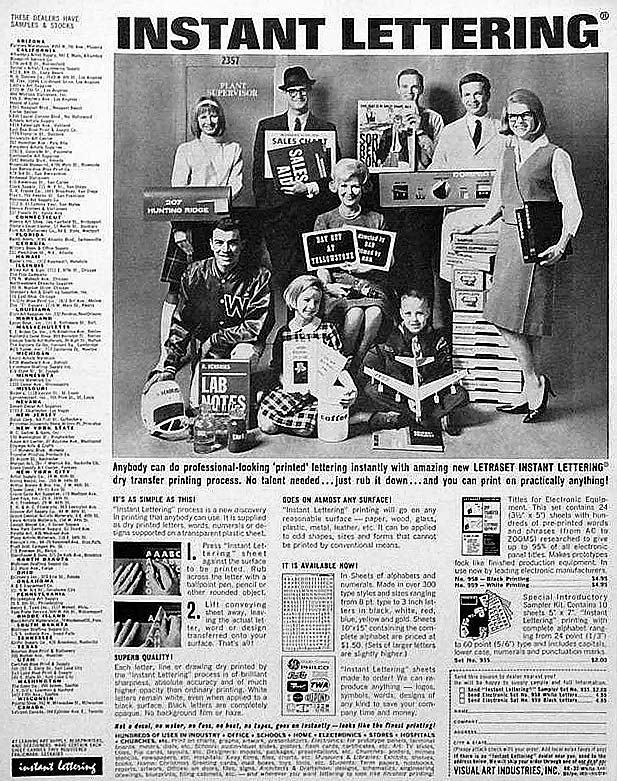
The History of Dry Transfers: Letraset - Image Transfers BlogImage Transfers takes the Letraset products to the next level. All we do are custom dry transfers and our process differs; we don’t mass produce transfers.
Any variation of letter spacing would be the tell in that case. A comp consisting of a white letterboard with Ruby or Amberlith film overlay for process camera production of a photo silk screen stencil makes a lot of sense. My boards were done in a local house by that process with 4x Rubylith film cut on my plotter for type, logo and traces circa 1988. edit: details I won't go into as yet lead me to believe the line art was done was done the art department. A set of photos made on a copy stand such that a 640x480 template for each character in Fontographer will make it much easier to identify the face if transfer lettering. If not, I've done a number of partial fonts and a lot of graphics in that first release (a full year ahead of AI release) Illustration application. Reproducing that face in Fontographer sounds like a lot of fun should it come to that. 😉 | |
| 1 |