68kMLA Classic Interface
This is a version of the 68kMLA forums for viewing on your favorite old mac. Visitors on modern platforms may prefer the main site.
| Click here to select a new forum. | |
| Lisa 2 / Mac XL prototype cable | |
| Posted by: elemenoh on 2021-01-06 18:45:03 As I was stripping down the Mac XL I'm restoring I noticed this wiring harness says 'Prototype'. Curious to know if any production units shipped with a label like this or if it's indicative of the whole unit being a prototype. The rest of the unit seems normal, but I'm new to Lisas so might be missing other signs. It was made in February 1982. Maybe an early production thing? 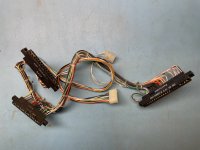 | |
| Posted by: maceffects on 2021-01-06 19:56:23 What’s your Lisa’s Model Number? If it’s A6S0100 it started as a Lisa 1 and was upgraded. 1982 would be more in line with that. In the early days at Apple it was common to use parts available. If you had prototype connectors you used them so long as they were the same specs and production parts. The harness itself has a later 1983 date code, however, which is unusual unless it was a prototype harness for the Mac XL but I’m not sure if it would even be different. | |
| Posted by: elemenoh on 2021-01-07 06:33:55 @maceffectsThe model is A6S0300 with memory option A6S0304. Do you know what the "Applenet" number refers to? | |
| Posted by: maceffects on 2021-01-07 06:48:00 OK, yours definitely started life as a Mac XL and was never an upgraded. AppleNet never really happened. Here’s more info on that https://github.com/stepleton/applenet | |
| Posted by: elemenoh on 2021-01-07 06:54:23 So this is possibly an earlier Apple-owned production device that had a cable revision being tested? | |
| Posted by: maceffects on 2021-01-07 07:07:31 It could be that or simply it was leftover parts. It’s really hard to say. I’d like for signs of having an Apple asset tag. For example, a spot where one was affixed would have less yellowing. | |
| Posted by: elemenoh on 2021-01-07 07:16:10 I don't see any witness marks like that. It's a mystery for now 🙂 | |
Posted by: ScutBoy on 2021-01-07 07:56:19 I need this networking icon! 🙂 | |
| Posted by: olePigeon on 2021-01-07 10:01:40 I noticed you're in the Bay Area. If that system came from Shreve Systems, it's possible they threw in a miscellaneous working cable. I think they got a whole ton of Lisa and Mac XL stuff at one point. Wouldn't surprise me if they got a bunch of pre-production parts that work just as well as the final parts. | |
| Posted by: stepleton on 2021-01-07 12:53:29 Oh interesting. You know, I don't think this is the first time I've seen a picture of that wiring harness with the "PROTOTYPE" label, although I forget the other circumstance. My dim recollection is that there was no other indication that the computer was an unusual machine. I've been off-and-on trying to reverse engineer the Applenet card for a long time (mostly off, thanks to other projects :lisa2: ), and the github linked is all the progress I've been able to make so far. The two big steps left to go are to understand what the GAL does (the equations are on bitsavers) and what the Z8 microprocessor is up to. If anyone feels up for a challenge, I'll gladly walk them through everything I've learned. (It's all on the github for the most part though.) | |
Posted by: maceffects on 2021-01-07 14:29:09Oh interesting. You know, I don't think this is the first time I've seen a picture of that wiring harness with the "PROTOTYPE" label, although I forget the other circumstance. My dim recollection is that there was no other indication that the computer was an unusual machine.Yeah, I remembered seeing this somewhere else too, but I cannot recall the circumstances either. AppleNet seems like a sounds like a great project. It is probably a very niche one but still cool nonetheless. If I had more knowledge in that area, I'd volunteer to help. | |
Posted by: cheesestraws on 2021-01-08 00:46:26Oh interesting. You know, I don't think this is the first time I've seen a picture of that wiring harness with the "PROTOTYPE" label, although I forget the other circumstance. My dim recollection is that there was no other indication that the computer was an unusual machine. Yes, same, though once again I cannot remember precisely when and how. But I think there is precedent for a prototype-labelled wiring harness ending up in a production machine which is apparently unremarkable | |
Posted by: sunder on 2021-01-11 03:00:36@maceffectsThe model is A6S0300 with memory option A6S0304. The Lisa contains two serial numbers inside the VSROM - one is the serial number of the Lisa itself, the 2nd is the AppleNet ID which is sort of like a MAC address in modern ethernet cards. These latter ones were to be used with the proprietary AppleNet network cards to identify a Lisa on an AppleNet network. You can see these values by powering on your Lisa, not inserting a floppy, then telling the Lisa to boot off the floppy drive. When it throws an error saying insert a floppy, press Apple-Shift-S to get into service mode, and then select "1" to display memory and then type in 240 for the address and I think 80 or 40 for the count. (off the top of my head). The first 32 bytes are the serial number, the 2nd are the AppleNet ID. These sometimes match the physical sticker on the chassis, unless ofc the CPU board has been moved from another Lisa, etc. Lisas with the 3A Video modification kit do not have any serial numbers and will display zeros in this location. While a few prototype AppleNet cards and hubs were created these never went to market, and instead Apple switched to using the built in serial port at ~223Kbps AppleTalk, which later changed to use RJ11 phone wires, called PhoneNet. Eventually when Ethernet became available, they ran the same AppleTalk over ethernet and called it "EtherTalk" and renamed the older AppleTalk protocol to "LocalTalk". EtherTalk used a slightly different signalling scheme CSMA/CA vs CSMA/CD to avoid collisions, unlike normal ethernet, which basically sent a short reservation topic (sort of like raising your hand before you speak) which silenced all the other workstations for a short period of time. Neither forms of AppleTalk were based on AppleNet, and we don't really know what the AppleNet software looks like as it hasn't surfaced. Tom Stepleton has created dumps and reverse engineered schematics of these AppleNet cards here: https://github.com/stepleton/applenet It may be possible that the same folks that worked on AppleNet designed AppleTalk, or it may be competing teams that built something completely different. We don't know. There's no software for these, unless you count the boot ROM on the AppleNet cards, which would have allowed a Lisa to boot off an AppleNet network. You can find some general details here: | |
Posted by: sunder on 2021-01-11 03:04:50You can find it here: https://github.com/stepleton/applenet/blob/502daf70fb9d7d8a5594a588aa4b4893f61f3ecf/applenet_boot_rom.txt#L867 It's in PackBits format I think. | |
| 1 |