68kMLA Classic Interface
This is a version of the 68kMLA forums for viewing on your favorite old mac. Visitors on modern platforms may prefer the main site.
| Click here to select a new forum. | |
| Alternative LocalTalk cabling | |
| Posted by: cheesestraws on 2020-03-08 13:05:46 I'm probably going to install LocalTalk cabling in my new office/workroom while I install Ethernet, because it means I don't have cabling thrown across the room while I'm experimenting and it won't be much extra effort. Has anyone here run LocalTalk over CAT5/6? As far as I can see it ought to work fine: the signal integrity ought to be fine, and CAT5/6 has a characteristic impedance of ~100ohms which matches the termination in LocalTalk boxes. The sensible (hah) option here would be to get telephone-type wiring installed and just use PhoneNet, but I don't have any PhoneNet equipment, and also mini-DINs look cool... | |
| Posted by: LaPorta on 2020-03-08 13:13:20 Let me put it this way: I made the most ghetto, phone-cable-based network that ran throughout my parent's house when I was a kid. It even included a TWO TO ONE wire adapter as a splitter between three machines instead of chaining then from one to the next, which is not allowable at all. Somehow it all worked. My friend and I even ran what was probably the equivalent of 2,000 feet of phone cable between our houses, and, even though it was slow as heck, still worked. And this was 99¢ store cable. The point of this rant: whatever you rig up, it should work. | |
| Posted by: cheesestraws on 2020-03-08 13:17:38 ... you raise a very good point. LocalTalk would probably run over wet string by any modern standard. And many contemporary ones. (In my defense, I've been reading up on really picky stuff recently, so I'm stuck in that mindset) | |
| Posted by: adespoton on 2020-03-28 11:05:03 I'd stick to Cat 6/6e cabling (what I have) and then just use a modified PhoneNet adapter to connect to it. The impedance shouldn't be an issue, it's designed to tolerate way greater interference, and you can re-purpose the cabling for many other things (I also run my DC voltage over the PoE line to USB charge ports). | |
Posted by: cheesestraws on 2020-03-28 11:45:53(I also run my DC voltage over the PoE line to USB charge ports). Now that's a good idea. | |
| Posted by: lisa2 on 2020-03-28 14:56:51 PhoneNet was designed to use existing building wiring ( Cat3 ). I have run LocalTalk over Cat5e cables for decades, I even use standard Cat5e Ethernet (RJ45) jacks. Regular phone patch cords (RJ11) will plug-in and work fine with the RJ45 in the wall to connect the Phonenet adapters. Only thing is that you need two jacks at each location for daisy-chaining. I currently use a GatorBox with a LocalTalk repeater and make home runs for each node like twisted pair Ethernet. Rick | |
| Posted by: cheesestraws on 2020-03-28 15:02:24 Perhaps this is an eccentricity, but I really like the aesthetics of the Mini-DIN. I ended up making some custom faceplate things, yes, with two jacks at each location for daisy-chaining. Each of these will have CAT6 behind it (overspecced, but that's what I have a huge roll of, so be it). 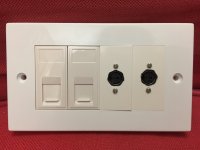 | |
| Posted by: mactjaap on 2020-03-28 16:12:45 Cool! | |
| Posted by: sfiera on 2020-03-29 20:19:38 Where are you getting your 3-pin cables? They seem pretty scarce these days. | |
Posted by: cheesestraws on 2020-03-30 03:19:24Where are you getting your 3-pin cables? They seem pretty scarce these days.The cables are scarce, but the connectors themselves seem reasonably obtainable. The connectors in the faceplates I just got from RS's "own brand", and I got a few cables made up by a company who do custom audio and data cables, and the male connectors were part of their standard supplier's range too, so I'm guessing someone somewhere must still be using them for something? Interestingly, RS sell cable assemblies with a 3-pin mini-DIN on one end and bare wires on the other, but not a straight-through cable. So who knows. They aren't the locking connectors, just standard mini-DIN, but so far they seem to work (I haven't really tested them in anger yet). It was moderately, but not unbearably expensive to get them made; no more so than it would be to get any other custom serial cable made, I suppose? I think they were about 15GBP each, maybe slightly more. | |
| 1 |