68kMLA Classic Interface
This is a version of the 68kMLA forums for viewing on your favorite old mac. Visitors on modern platforms may prefer the main site.
| Click here to select a new forum. | |
| Centris 610 broken pin on IOSB chip (fixable?) | |
| Posted by: avadondragon on 2016-01-09 12:03:14 Last month I recapped 2 Centris 610 motherboards. One came back to life but the other booted with chimes of death so I put it aside. I was just interested in playing with A/UX and I only needed one machine for that so I wasn't worried about fixing both. However, once I got my A/UX machine up and showed it off to some of my other local Mac enthusiasts one of them got very excited and offered me his SE/30 and Classic II in trade (which would complete my compact mac collection). This gives me incentive to repair the other Centris as well. I STILL want an A/UX machine to play with! After going over every inch of the PCB with a microscope I noticed one of the leads on the IOSB chip was broken. I took a file to the ceramic of the chip to see if I could expose more conductor to somehow repair the break but it is just so damn tiny I can't think of any way to manage it. Does anyone have some idea how that could be repaired short of pulling the chip and replacing it? I suppose replacing it is an option if I could get the part. I am not 100% certain this will fix the board though. | |
| Posted by: 360alaska on 2016-01-09 21:45:32 Pics? | |
| Posted by: avadondragon on 2016-01-10 13:40:05 Here's a pic: 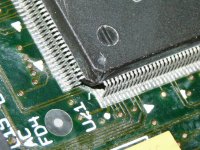 | |
| Posted by: apm on 2016-01-10 15:12:18 Conductive epoxy might work, but turns out a tiny tube of the stuff is more expensive than a whole new machine! Conductive paint is cheaper, but I don't know if it would have enough strength or long-term resilience. I might try to solder it. First, get a flux pen and put a healthy amount of flux on the stub of the pin. Then take a resistor leg, solder it down to the pad first, and bend it up toward the chip, so it rests against it without strain. Put a little blob of solder next to where it would contact the pin, then reheat right next to the pin and see if the two will flow together. It'll take a fine-tip iron, and even so it might just be too little surface area, but it's worth a try before pulling the whole chip off. | |
| Posted by: techknight on 2016-01-10 17:47:47 I have a few Centris/Quadra boards for that form-factor for parts. probably work, but probably dont. If you need that chip, I can heatgun it off. Or send you the whole board? | |
| Posted by: Floofies on 2016-01-10 17:49:00 A solder reflow station (hot air gun) would work wonders for apm's suggestion. Costs around $50 and would be easier than using just a soldering iron. | |
| Posted by: avadondragon on 2016-01-10 18:32:23 @apm: Thanks for the ideas. I think I will look around and see if I can pull a lead off of some junk board and use it (I don't think a resistor lead will be small enough) I have conductive paint available but will try to solder it first. I also have a hot air station available but I'm not sure how I wold be able to use it to reconnect the lead to the chip. @techknight: If I can't fix the chip, which is likely, I may be interested in acquiring a Quadra board from you. | |
| Posted by: 360alaska on 2016-01-13 19:51:10 Allot of times the pins on the end are no contact, you should see if that pin actually goes somewhere... | |
| Posted by: trag on 2016-01-13 22:16:03 On some of Apple's ASICs, I've found that about every fifth pin is a power or ground pin. You should chec; whether the corresponding trace goes directly to power or ground. If it does, while it is less than ideal, the chip can probably live without it. There are typically lots of redundant power/ground pins on big ASICs. | |
| 1 |