68kMLA Classic Interface
This is a version of the 68kMLA forums for viewing on your favorite old mac. Visitors on modern platforms may prefer the main site.
| Click here to select a new forum. | |
| Brand New SE/30 Logic Board | |
| Posted by: ants on 2018-06-26 20:37:35 I nabbed this off eBay as soon as I saw it. It's in impeccable condition, with original service box. I haven't tested it yet though! I'll replace the battery ASAP, and I guess I should do the caps too? Although they look perfect. 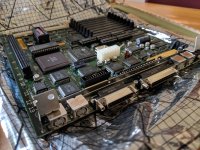 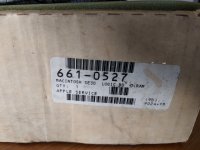 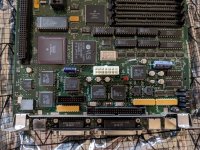 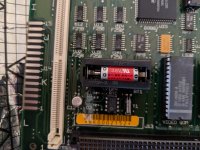 | |
| Posted by: tanaquil on 2018-06-28 08:52:43 Sweet! Service box and everything, I bet that is valuable in its own right. Like you said - get that Maxell bomb out of there! I believe the SE/30 will start without a battery, so you don't have to replace it with anything unless & until you want the clock to keep good time. From what I understand caps are definitely worth replacing before they leak and create havoc with their goo (not as bad as Maxell havoc but still bad). That's just my impression from these forums though. | |
| Posted by: davidg5678 on 2018-06-28 09:07:53 I believe I read that once the caps are powered on, the process of leaking accelerates. I definitely second tanaquil on replacing the caps. They will fail. | |
| Posted by: techknight on 2018-07-02 09:57:40 I can tell by looking at the caps they are already leaking, just not as bad as it wasn't exposed to the same environment these machines usually are when they "sit". | |
Posted by: ants on 2018-07-02 12:57:52I can tell by looking at the caps they are already leakingYep, upon closer inspection they are. I have some nice Panasonic Tantalum capacitors I'm going to try. I tried using Tantalum's on my last logic board, but gave up in frustration and switched to electrolytic ones with nice big legs on them! I think my soldering skills have improved since then, so fingers crossed!! | |
| Posted by: trag on 2018-07-02 15:08:18 If you're planning to solder capacitors with legs in place of surface mount capacitors, I urge you to reconsider. It really is more difficult to do that than it is to just install surface mount caps. Also, installing caps with legs, creates a situation in which one can easily apply physical leverage on the solder pad through the cap body and tear the solder pad off of the circuit board. | |
| Posted by: ants on 2018-07-02 16:00:32 For an absolute beginner like me, installing caps with legs was much easier than surface mounts - I guess it comes down to personal ability. I bent the caps 90 degrees and applied some hot glue - it's ugly but prevents the solder pads from being broken if I knock the caps accidentally. But I will try surface mounts again this time around - I've got a much better soldering iron which I think will make the task a lot easier. | |
| Posted by: trag on 2018-07-02 18:06:13 Try this technique. Get the old caps removed. Remove the old solder, so that you have flat pads. Clean the board and remove all the flux residue. For each capacitor, there is a pair of pads. Melt a little solder onto one pad out of each pair. Just one, not both. Now, set a capacitor into position. Use a tweezers, if needed. Gently press down on top of the capacitor (use the eraser end of a pencil, or a flat-heaad screw driver or some such) to hold it in place. Apply your soldering pencil to the pad which already has solder on it. Let the capacitor sink into the solder down to the pad. Be sure to heat both the pad and the capacitor terminal with your pencil, so you'll get a good joint. Cold joints happen when one or both terminals being soldered don't reach solder melting temperature. Remove the soldering pencil. Wait a few seconds. Remove the tool pressing on the cap. Now solder the other terminal, the way you would solder anything else. Apple heat to the pad and terminal. Melt the solder onto the pad and/or terminal. Remove solder and heat. Rinse. Repeat. I cannot see how this is more difficult than soldering a wire to the pad. But I may be blinded by my point of view. | |
| Posted by: ants on 2018-07-02 18:25:17 Thanks @trag. The big issues I had was getting my soldering iron under the capacitor to melt the solder. Perhaps it's just the Panasonic caps, but they fully covered the soldering pads. I ended up holding my soldering iron for far too long on the motherboard and I started to panic that I was going to destroy it and/or the capacitors. That's when I switched to electrolytics... At the time I also had a really crappy soldering iron that had a blunt end and delivered not enough heat. I've got a temperature-controlled one now with a nice pointy end on it. I'll try again soon, and post photos of my issues if I get stuck... | |
| Posted by: CC_333 on 2018-07-02 19:32:16 Yes, nice pointy tips are better for this sort of thing. Blunt tips are worthless for anything other than soldering large wires together (i.e., splicing), in my opinion. c | |
| 1 |