68kMLA Classic Interface
This is a version of the 68kMLA forums for viewing on your favorite old mac. Visitors on modern platforms may prefer the main site.
| Click here to select a new forum. | |
| Cheaper by the dozen? Compact mac compatibility | |
| Posted by: tanaquil on 2018-06-07 18:25:41 I am embarking on a long project. I have been trying to take stock of my inventory, and it appears that I have an even dozen of Compact machines, ranging from 128K to a mystic Color Classic. The goal is to get at least one model of each generation working. I am now able to declare the 128K working apart from the lack of a working internal disk drive (it does boot from an external disk drive), so that is step one. Next I have two 512Ke machines and a Plus that are in parlous condition. (I have a working 512K with HyperDrive but frankly I am not touching that, if it ain't broke don't fix it.) Following them, I have two working SE machines, at least one SE of uncertain condition, a Classic in the process of being rebuilt, and a working SE/30 that I am trying to Frankenstein together with a non-working SE/30 (the working one has a messy case and minor analog board problems). And then there is the Color Classic, which was working last I remember, but is not starting now, and honestly I might have disconnected a bunch of stuff, I'm not sure. It will be last as I am working my way up the chain. Which machines can be used to bench test other machines? What makes me nervous is that I am not willing to risk my working 128K and my working 512K, so I don't want to plug boards of unknown status into those machines. Am I right in thinking that it is no good trying to test (say) a 512Ke logic board with a known working SE analog board? I know there is a certain amount of continuity in the 128/512/Plus family and in the SE/SE-30/Classic family but maybe not between the two. If the two groups cannot grok together I will see if I can rebuild a working Plus bench model and go from there. Advice welcome! | |
| Posted by: tanaquil on 2018-06-07 18:58:41 A follow up question: if I want to put my old, dusty, not-sure-if-they-work-or-not boards through the dishwasher (no soap), is there anything I need to remove first for safety? | |
Posted by: bibilit on 2018-06-07 23:43:43A follow up question: if I want to put my old, dusty, not-sure-if-they-work-or-not boards through the dishwasher (no soap), is there anything I need to remove first for safety?The battery and ram | |
| Posted by: tanaquil on 2018-06-08 16:03:38 Thanks! RAM and (socketed) ROM will be removed accordingly. Good news: I discovered while continuing to test that one of my 512Ke machines is fully working. (I don't know why I didn't remember this? I think I set the 512Ke aside in disappointment when I discovered it was not an original 512K - I was questing for a 512K at the time - and I already knew my other 512Ke machine had serious problems.) While I hate to disassemble any fully working machine, 512Ke is not a high priority in my collection, so I should be able to use this as a bench/test machine for both logic and analog boards in the 512K and Plus generation. I am conflicted... I love the cuteness of the compact Mac form factor but hate the disassembly/assembly. I am going to have to swap in about six different analog boards to test their status. I foresee a lot of dented and scratched fingers. | |
| Posted by: tanaquil on 2018-06-08 17:01:07 The next Compact frontier: before I start testing my million and one unknown analog boards, I have a Mac 512K board with a MacSnap upgrade that needs diagnosis. This came out of a (labeled) 512Ke machine that I know was not working when I disassembled it many years ago, but the fault might have been in the analog board, jury's still out on that. I would like to wash this poor dusty beat up set of boards in the dishwasher but I'm hoping to get visual feedback from the community first. 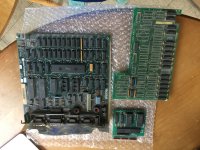 -- Am I right in thinking that there are no chips to remove before I put these boards (at least the bigger two, the SCSI board might be ok) in the dishwasher? -- Any obvious trouble spots on the board (besides dirt)? I see none but I have no expertise. -- There are two RFI shields... I have no idea why. Was that an upgrade thing? Did I put two shields together by accident at some point? (The latter is completely possible. I think this board sat on top of a bunch of junk on my workbench for at least ten-fifteen years.) -- I assume the RFI shields don't go in the dishwasher. Tips for cleaning them safely? 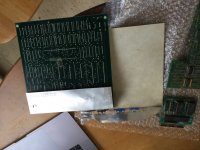 How I am going to put these snap boards back together after they are cleaned is another adventure altogether. One thing at a time! | |
| 1 |