68kMLA Classic Interface
This is a version of the 68kMLA forums for viewing on your favorite old mac. Visitors on modern platforms may prefer the main site.
| Click here to select a new forum. | |
| Getting G3 Whisper Perch USB working | |
| Posted by: croissantking on 2023-03-13 11:45:11 Just under the Firelink chip in your photo there are a whole bunch of them. | |
| Posted by: mg.man on 2023-03-13 11:49:02 OK, will try to get a closeup. | |
| Posted by: croissantking on 2023-03-13 15:02:08 Do I want a slow blow or fast blow fuse at F1? | |
Posted by: Phipli on 2023-03-13 15:02:58Do I want a slow blow or fast blow fuse at F1?Fast blow I'd say. | |
| Posted by: Phipli on 2023-03-13 15:03:46 Or fit a polyfuse? | |
Posted by: mg.man on 2023-03-14 03:38:11Just under the Firelink chip in your photo there are a whole bunch of them.Any better: ? | |
Posted by: croissantking on 2023-03-14 03:39:18Any better: ?Yes; cheers! | |
| Posted by: croissantking on 2023-03-14 04:24:31 I'm trying to work out what oscillator to use, I know for certain it's a 48Mhz part and probably 5V at that. Not sure what SMD package type would fit since the plastic ones don't seem to be made anymore, and the ceramic ones I've been perusing on Mouser are bloody tiny. Is an oscillator even needed at all? In @zefrenchtoon 's picture of the Yikes! motherboard, there's just an empty pad where that would go; equally, some PCI USB cards have the oscillator while others omit it. I read that the USB chip can generate its own internal clock but it's less reliable than an external crystal. It is interesting that the Yikes! motherboard employs a pair of poor man's fuses as over-current protection rather than a chip. Were there reliability issues with USB on those machines? -- I have definitely done something screwy with GND. Surely it's not right if there's +5V on the VSS bus, because VSS is a return path, isn't it? | |
| Posted by: mg.man on 2023-03-14 05:27:05 FYI, another one out there : 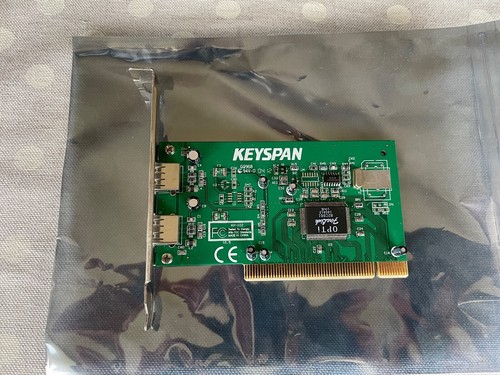
Vintage Keyspan USB Card for Mac - used in PowerMac 8600/200 | eBayFind many great new & used options and get the best deals for Vintage Keyspan USB Card for Mac - used in PowerMac 8600/200 at the best online prices at eBay! Free delivery for many products.
www.ebay.co.uk
| |
Posted by: Phipli on 2023-03-14 06:28:06I'm trying to work out what oscillator to use, I know for certain it's a 48Mhz part and probably 5V at thatWhat are the dimensions? Would a 0705 part fit? (7mm x 5mm) | |
Posted by: croissantking on 2023-03-15 14:20:29What are the dimensions? Would a 0705 part fit? (7mm x 5mm)Just looked at this. Yes, it's 7x5mm. | |
Posted by: Phipli on 2023-03-15 14:45:28Just looked at this. Yes, it's 7x5mm. 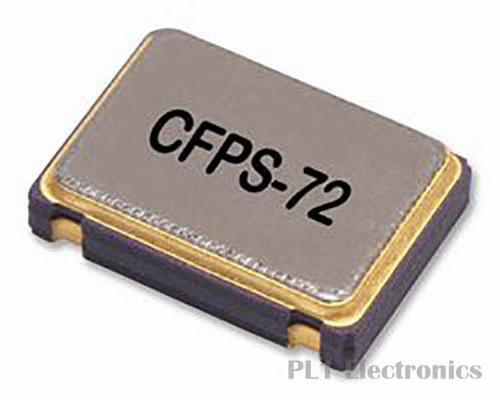
IQD FREQUENCY PRODUCTS LFSPXO019884 OSCILLATOR, 48MHZ, 50PF, SMD | eBayFind many great new & used options and get the best deals for IQD FREQUENCY PRODUCTS LFSPXO019884 OSCILLATOR, 48MHZ, 50PF, SMD at the best online prices at eBay! Free delivery for many products.
www.ebay.co.uk
I think that is what you are looking for. | |
| Posted by: Phipli on 2023-03-15 14:46:15 Bit pricey, but 5v 0705 parts are getting hard to find. Most are lower voltage. | |
Posted by: croissantking on 2023-03-15 15:21:56I think that is what you are looking for.Thanks, that's really helpful. | |
Posted by: zefrenchtoon on 2023-03-16 01:48:05@mg.man @zefrenchtoon What are the resistor values used, I can't quite see?Sorry for the delay, here is my best shot I think. Very hard to do without a real macro lens. 🙁 | |
| Posted by: croissantking on 2023-03-16 19:28:51 I have a new multimeter that can test capacitance, and have been examining the SMD caps on my Belkin donor card. The ones by the USB ports measure 0.5nf whereas most of the others on the card are 100nf. However there are some pink ones that don’t seem to have any capacitance at all, nor continuity. Is there such a thing as dummy capacitors? Also, could someone please tell me the difference between a ‘pull-up’ and ‘pull-down’ resistor (as these are referenced in the USB chip documentation) and how to tell which is which based on capacitance? | |
Posted by: mdeverhart on 2023-03-16 19:57:26Also, could someone please tell me the difference between a ‘pull-up’ and ‘pull-down’ resistorA pull-up resistor is connected between a signal and the power rail (say +5V), so that the signal is “pulled up” to a logic 1 if it’s not driven by an active driver, while a pull-down resistor is connected between a signal and Ground so that the signal is “pulled down” to a logic 0 when undriven (this assumes positive logic, where the higher voltage is a 1 and 0V/GND is a 0). Typical values for pull resistors are 1k - 100k Ohms, though others are possible. A lower resistance is a “stronger” pull, in that the driver must source or sink more current in order to overcome the “pull”, while a high resistance is a “weaker” pull, as less current is required. | |
Posted by: croissantking on 2023-03-17 03:32:42A pull-up resistor is connected between a signal and the power rail (say +5V), so that the signal is “pulled up” to a logic 1 if it’s not driven by an active driver, while a pull-down resistor is connected between a signal and Ground so that the signal is “pulled down” to a logic 0 when undriven (this assumes positive logic, where the higher voltage is a 1 and 0V/GND is a 0).Thanks! I think I am going to have to blindly experiment with capacitor and resistor values. | |
Posted by: Phipli on 2023-03-17 03:40:33Thanks!You shouldn't need to? | |
Posted by: croissantking on 2023-03-17 03:42:20You shouldn't need to?How do you mean? When populating the empty Cx and Rx pads I don’t know what values were intended for them. | |
| < 3 > |