68kMLA Classic Interface
This is a version of the 68kMLA forums for viewing on your favorite old mac. Visitors on modern platforms may prefer the main site.
| Click here to select a new forum. | |
| New CPU Accelerator options for 68K Macs? | |
Posted by: moldy on 2021-01-12 12:39:38Here's one to start with - runs a 68000 at 16MHz, includes 16K of Cache and a 68881 FPU...That's great, thank you! I haven't found this one when looking for existing designs with at least basic glue logic descriptions. | |
| Posted by: techknight on 2021-01-13 04:09:16 Dang. needs translated though. | |
Posted by: demik on 2021-01-13 11:01:25Here's one to start with - runs a 68000 at 16MHz, includes 16K of Cache and a 68881 FPU... Question about a cache like this : is it cache useful if you pair a 68000 with a ram fast enough so that every memory access is zero wait states ? | |
Posted by: JDW on 2021-01-13 14:11:21Dang. needs translated though. Just play a few hours of Wolfenstein 3D and then read through it again. You still won't understand it, but it will be far more enjoyable! ;-) | |
| Posted by: Kai Robinson on 2021-01-13 15:49:25 I read it parsing the text through google - was accurate enough to understand! | |
| Posted by: Frobozz on 2021-01-14 13:35:50 There's a Total Systems 68030 accelerator for the Plus up right now on eBay: https://www.ebay.com/itm/Mac-Plus-Logic-Board-w-Quesse-68030-Accelerator-incl-68882/333855393411 Doesn't say how much RAM is installed, and it looks like the Mercury version, which I believe is only 16mhz. is it like fantastically hard work to reverse engineer/copy one of these? I've seen the 040 reproduction for the SE (if I remember right) here. Hardware is a mystery to me. If I touch it, I'm pretty much guaranteed the magic will leak out. | |
| Posted by: Kai Robinson on 2021-01-14 14:06:50 The PCB itself - no. The GAL's on the board? Yes, unless you're lucky and they're 16V8's in combinatorial logic mode. Else you'll have to deconstruct the GAL logic using a logic analyser. | |
Posted by: techknight on 2021-01-14 14:44:03Else you'll have to deconstruct the GAL logic using a logic analyser. something ive never been able to master. | |
| Posted by: Bolle on 2021-01-14 18:56:43 This is the 16MHz Mercury indeed. It is limited to 4MB of RAM on the accelerator. I happen to have the schematics and GAL codes for both the accelerator itself as well as the RAM extension board. Never got around to actually build any clones of it yet though. Working on another SE 030 accelerator right now that will support 16MB RAM and go up to 50MHz (and has video output as well) I felt like the entry level Mercury wouldn’t be worth the trouble... | |
| Posted by: maceffects on 2021-01-14 19:12:55 That project might render the Brainstorm clone project I’m working on a bit inferior. However, I’m sure I’d buy one. I’d still love to get my hands on one of your socketed SE/30 upgrades if you ever do it again. | |
Posted by: mg.man on 2021-01-14 21:48:41it looks like the Mercury version It certainly says Mercury 030 Plus on the 'board... but the one I have is for the SE as well, and has a PDS connector. No sign of that on this one... This is the 16MHz Mercury indeed. Are you sure? The oscillator is 20Mhz... that memory expansion does look like a later one... v1.2... How many flavors of these did they actually make? Are there any ex-Total Systems ppl still kicking around? | |
Posted by: Bolle on 2021-01-14 22:01:01Are you sure? The oscillator is 20MhzThe oscillator is only connected to the FPU. The CPU is hardwired for 16MHz. that memory expansion does look like a later one... v1.2... How many flavors of these did they actually make?According to a product catalog from back then which I saw somewhere on archive.org the Mercury never did more than 4MB. While we're at it: View attachment Total Systems Mercury.zip Totally not tested and schematics have not been cleaned up for readability. Most parts values missing, you'll have to source those from the pictures. GAL files are however correct and tested. | |
Posted by: mg.man on 2021-01-14 22:16:16The CPU is hardwired for 16MHz. Good to know... Speaking of while we're at it... I recently acquired a Gemini 030 in a sad state... it's configured for an SE, but it doesn't appear to be working... all I get when powering up is this... no "bong", no pointer... :-(  I suspect it's because one of the GAL? chips is missing [U4, upper left] (but really have no idea)... 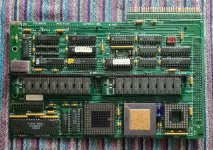 Open to any suggestions or happy to send to you if you want / have time to take a look... Does the file you attached include GAL details for the Gemini? | |
Posted by: Bolle on 2021-01-14 22:25:29Does the file you attached include GAL details for the Gemini?Nope, those files won't help you there. If the GAL in that open spot is indeed needed I'd say there's not much I can do for you without another one of those which has the needed GAL in place to make a copy. Seeing you've got the power connector on there though makes me wonder if you need a secondary power supply hooked up to get it to work at all. Can you meter out if the VCC pins on the PDS connector are even connected to any components on the accelerator? On the Mercury there are several jumpers to select different power sources... In the SE it would be obvious to have everything powered through the PDS connector. On the Plus you can choose to get power through the 68000 clip or an external power supply. It's the same with Quik30 I got in my Classic which needs a secondary power supply to work at all as there is no power supplied to the accelerator through the clip that goes onto the logicboard CPU. | |
Posted by: mg.man on 2021-01-14 22:35:40Nope, those files won't help you there. Yeah... I d/l'd and saw they were Mercury-specific... drat! not much I can do for you without another one Feared that as well... I know a couple of MLA'rs have one of these... but set up for a Plus - the ones I've seen do have a chip at U4. :-( My only hope is that it's only required in "Plus" mode... but that's likely a wild hope... makes me wonder if you need a secondary power supply hooked up to get it to work at all. Yeah... I've been wondering that too... I'll see if I can do some probing... Thanks for the info / suggestions! | |
| Posted by: mg.man on 2021-01-15 01:52:39 Doesn't look like it's a VCC issue... compared this 'board to my [working] Mercury 030 and the +5V pins from the PDS are carried onto the 'board. In fact, they are connected to the two right-most pins of the power connector... :-( | |
| Posted by: CharlieFrown on 2021-01-15 03:07:57 another clever idea - Raspberry Pi emulates really fast 68000 CPU with huge chunk of memory while the rest of original hardware works as usual https://twitter.com/Claude1079/status/1330154148113887234 | |
| Posted by: Kai Robinson on 2021-01-16 04:32:03 Uploading this, for those that might be interested in a 68020 accelerator design. View attachment Wireless World, July 1987 - 68020 cache design.pdf | |
Posted by: trag on 2021-01-16 21:46:21Uploading this, for those that might be interested in a 68020 accelerator design. Nice find. Thank you for posting it. | |
| Posted by: Kai Robinson on 2021-01-19 10:33:34 And this article, too...plenty of information for the basics, there. View attachment 68020 Coprocessors.pdf | |
| < 3 > |