68kMLA Classic Interface
This is a version of the 68kMLA forums for viewing on your favorite old mac. Visitors on modern platforms may prefer the main site.
| Click here to select a new forum. | |
| Made ROM SIMMs, wrote ROMdisk driver, need help debugging | |
Posted by: pax on 2020-07-15 13:40:18On the subject of HD20 support, I don’t believe my ROM has this, since it’s not in the IIsi base ROM (right?)I think the IIsi stock ROM does support HD20, while it’s missing from IIx, IIcx, IIfx and SE/30. | |
Posted by: ZaneKaminski on 2020-07-15 13:58:25I think the IIsi stock ROM does support HD20, while it’s missing from IIx, IIcx, IIfx and SE/30.Huh, I just checked on my SE/30 and you're right, the IIsi ROM does support HD20 booting. That's strange because it says in the Mac IIsi Developer Note that it's only supported with an INIT. Well that's good! Edit: "IIsi Developer Note," not "IIci" | |
| Posted by: JT737 on 2020-07-18 00:22:36 Hey @ZaneKaminski, Good to see that this project is up and running again! I will also add as far as testing goes, I currently have several accelerators, including a Diimo 030, a Daystar Powercache 030 50mhz, a Sonnet 040, and a MicroMac Carrera040. I also have a Daystar Turbo 040, but I'm currently selling it...I need to as I "accidentally" spent to much money on something else! | |
| Posted by: ZaneKaminski on 2020-07-24 18:05:40 2MB SIMMs are being tested now, and I am so far hearing only good things! 8MB SIMM boards just arrived: 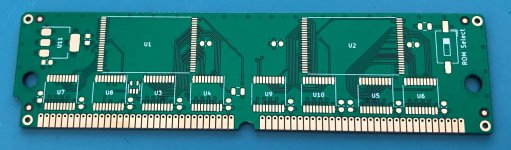 I'm waiting on a single part to come and then I can assemble these. Regarding the thickness, I was able to get a few quotes for 1.3mm boards. The best price was around $4 each, which is not bad if it solves the major issue with these ROM SIMMs. I began writing a manual for this thing a few hours ago when a little opportunity occurred to me. With a IIsi-based ROM, the IIx, IIcx, and SE/30 require a mod to the system file in order to run System 7.5. I should ship a little utility on the ROM SIMM that performs this modification this automatically. I'll start on this soon. | |
Posted by: JDW on 2020-07-24 18:45:16Regarding the thickness, I was able to get a few quotes for 1.3mm boards. The best price was around $4 each, which is not bad if it solves the major issue with these ROM SIMMs.I'm not sure why BMOW used such a thin PCB in light of the fact that the IIsi and IIfx ROMs all fit perfectly in the SE/30 in terms of thickness, with no connectivity issues whatsoever. Meaning, if you make a ROM thick enough to fit an SE/30, it should fit those other Macs just fine too. Maybe there was another Mac model that required a thinned PCB, I don't know. | |
| Posted by: ZaneKaminski on 2020-07-24 19:22:41 Oh, I forgot to ask in my earlier post: what software should I include on the 8MB SIMM? Currently I have:
What else should I include? Is System 7.0 the right choice or should I include 7.1? And can anyone point me to the best CD-ROM extension for System 7? Isn’t the Apple one not compatible with other manufacturers’ SCSI CD drives? Or am I just thinking of HD SC Setup? I think I should include a system diagnostic tool as well, but I’m not sure what. I’d welcome any suggestions about software. I'm not sure why BMOW used such a thin PCB in light of the fact that the IIsi and IIfx ROMs all fit perfectly in the SE/30 in terms of thickness, with no connectivity issues whatsoever. Meaning, if you make a ROM thick enough to fit an SE/30, it should fit those other Macs just fine too. Maybe there was another Mac model that required a thinned PCB, I don't know.It’s the imperial-to-metric transition that’s responsible. Original SIMMs are all nominally 0.05 inches thick, which is 1.27mm. Once upon a time, 0.05 in. was a common PCB thickness, and so was 0.06 in. (1.524mm). Now, however, metric dimensions are standard, and the commonly available thicknesses have been rounded to 1.2mm and 1.6mm. 1.6mm is way too thick, but 1.2mm is on the edge of the acceptable thickness. For example, one SIMM socket’s data sheet stated a minimum PCB thickness of 1.19mm. Depending on the type of socket used, which has some correlation with the model of Mac, as well as the thickness variation among boards, it works more or less reliably. | |
| Posted by: JDW on 2020-07-24 19:41:14 I prefer System 7.1. I don't know why anyone would use 7.0.1, actually. System 7.1 gives you a lot of what 7.5.5 offers, just without the bloat and sluggishness. If ROM thickness is 0.7mm too thin, why not up the copper? Not sure if that 1.2mm is measured from the outer edge of the front pads to the back side pads using 2oz of copper, but if it is, upping the copper to 3oz would increase the trace thickness by 0.051mm, which in turn would increase copper on both sides for a combined 0.102mm thickness increase, bringing the contact thickness to 1.2mm + 0.102mm = 1.302mm. But again, that assumes you are measuring 1.2mm when using 2oz copper traces. The question then becomes, is it worse to have a ROM 0.07mm too thin or 0.03mm too thick? | |
| Posted by: JT737 on 2020-07-25 06:59:03 @ZaneKaminski-I would say go with system 7.1 as well. I also like the fact that you've included Lido 7- very useful utility! I would say that you should also include SCSIProbe.....makes for a nice set of SCSI tools. | |
| Posted by: cheesestraws on 2020-07-25 07:18:47 Thirding 7.1. | |
| Posted by: ZaneKaminski on 2020-07-25 11:45:54 Thanks for the feedback! I'll install 7.1. Now about the CD extension, I generally use FWB CD Toolkit because I can set a massive driver cache size with it, but I think it would be more appropriate to include Apple's CD extension. Now, version 5.3.1 seems to be the right version to use, but this evidently shipped with System 7.6. Presumably this'll work with 7.1 (being that 7.5 and 7.6 are basically a bunch of extensions on 7 lol) but can anyone say otherwise? If ROM thickness is 0.7mm too thin, why not up the copper?Hmm, yes, this could certainly help. Both SIMMs have used 1oz copper thus far. 3oz is an unusual option but 2oz will at least make up half of the difference, if indeed the fabricator doesn't use a thinner core substrate to cancel it out. This will cost less than a 1.3mm board since the 2oz copper is a common option. I will try this in the future. | |
Posted by: JDW on 2020-07-25 12:01:32Thanks for the feedback! I'll install 7.1. Now about the CD extension, I generally use FWB CD Toolkit because I can set a massive driver cache size with it, but I think it would be more appropriate to include Apple's CD extension. Now, version 5.3.1 seems to be the right version to use, but this evidently shipped with System 7.6. Presumably this'll work with 7.1 (being that 7.5 and 7.6 are basically a bunch of extensions on 7 lol) but can anyone say otherwise?I don't have an Apple CD-ROM to test and confirm if the extension would not only load under 7.1 but also control the drive too. Perhaps someone else can do that though. I made errors on my copper thickness numbers yesterday. Since we cannot correct posts in this forum, I will just need to correct it here: PCB Copper Thickness: 1oz: 0.035mm 2oz: 0.070mm 3oz: 0.105mm 4oz: 0.140mm If indeed you used 1oz copper, and if your 1.20mm thickness measurement was based on that AND measured from the outer edge of the copper pads, then going to 2oz would make a thickness of 1.27mm! Perfect! | |
Posted by: cheesestraws on 2020-07-25 18:37:15Apple's CD extensionI’m going to throw the freeware CD Sunrise extension into the discussion here because that is small, universal and has been very reliable for me at least. | |
| Posted by: IlikeTech on 2020-07-25 21:37:00 TattleTech. Super useful for hardware related stuff. Also the SetDate utility, because otherwise you can’t set the correct date and time on anything older than OS 9. | |
| Posted by: Crutch on 2020-07-25 22:09:14 Macsbug! Please please please include Macsbug. 🙂 also System Picker. | |
Posted by: cheesestraws on 2020-07-25 22:45:50Macsbug! Please please please include Macsbug. 🙂Very very very much this. | |
| Posted by: Trash80toHP_Mini on 2020-07-25 23:46:43 Indeed! SCSI-Probe ADB Reset Gauge Series: I IRC it was released into the public domain or at least for non-commercial use, the modules are very useful alongside TattleTech Iomega Guest if it and Zip Drives are compatible with the Systems included along with System Picker. Has 6.0.8 been considered? If someone could build the "perfect" 6.0.8/MultiFinder/whatever image for you that would be great fun for comparison testing on these transitional machines. Is there such a thing as a ROM test utility as is common for RAM? If you haven't done so already, definitely write a test/data logger for spreadsheet (database?) import for your field testing report analysis. | |
| Posted by: JDW on 2020-07-26 05:57:02 “ADB Reset” seems to be ADB Renewer. I read the description of what it does, but I’ve actually never used it before. What is an example situation that crops up where this software solves the problem? The only time I had problems with ADB was in the distance past when I accidentally plugged in an ADB device while the Mac was powered, which is something you’re not supposed to do, as you could damage the hardware. | |
| Posted by: davidg5678 on 2020-07-26 21:52:23 What about a copy of Disinfectant or some kind of antivirus? This could be very useful to have on the ROM, as it could remove viruses from the main drives without getting infected itself -due to the nature of the ROM. | |
Posted by: Trash80toHP_Mini on 2020-07-27 01:43:06“ADB Reset” seems to be ADB Renewer.There's another one called ADB Reset that I keep on my KVM'd Macs. I read the description of what it does, but I’ve actually never used it before. What is an example situation that crops up where this software solves the problem?When switching back to a Mac from the KVM, sometimes the mouse fails to re-initialize. KBD never failed so I could hit TAB A and press enter to run ADB Reset the bus and bring the mouse back to life. The only time I had problems with ADB was in the distance past when I accidentally plugged in an ADB device while the Mac was powered, which is something you’re not supposed to do, as you could damage the hardware.Same thing as mechanical KVM switching, but the KVM switching eliminates joggled insertion hotplugging, controller endangerment. | |
| Posted by: Trash80toHP_Mini on 2020-07-27 01:48:45 Was any version of Expander released for unlicensed use? ISTR it being included on distro disks and in shareware collections. It's time to drag out all those magazine CDs to ransack them for freeware shareware collections. MacAddict had one included on the CD every issue. I'll bet a lot of apps could be added to the Garden if not this ROM. | |
| < 3 > |