68kMLA Classic Interface
This is a version of the 68kMLA forums for viewing on your favorite old mac. Visitors on modern platforms may prefer the main site.
| Click here to select a new forum. | |
| PowerBook 100 Accelerator Insanity | |
Posted by: EvieSigma on 2018-01-19 19:37:47I'm guessing the version with the optional memory upgrade card is an early edition. PCB's (c)1990, what's the date on yours?It's a larger board with integrated RAM sockets and completely different CPU/FPU positions, dated 1988:  | |
| Posted by: Trash80toHP_Mini on 2018-01-19 19:58:24 Nice! I only see two, are there two more SIMMs on the other side of the board? Is that empty socket labeled 68020? The later version seems a lot more tightly integrated with but a handful of GALs/PALs/whatever. GALs were a new thing in '85. In '88 you've got all that discrete DIP logic/DIP PALs or Gals and then just two years later everything is simplified into a few SMT GALs and a handful of SMT standard logic ICs! edit: forgot to ask for BIG piccies! [😀] | |
| Posted by: EvieSigma on 2018-01-19 20:11:22 Two more SIMMs, I don't recall what the empty socket is labeled. That's the biggest one I've got, guess I gotta take apart the 512k again and take more pictures! | |
| Posted by: Trash80toHP_Mini on 2018-01-19 20:22:30 That would be much appreciated! Maybe getting a look at the way the logic is set up on yours will give some clues as to what's going on in the more tightly integrated later version. Just realized I really need to downshift and cruise for a bit here. I'm not used to seeing anywhere near this much participation in one of my hacks threads. I'm getting a little manic, not good. :mellow: | |
| Posted by: EvieSigma on 2018-01-21 20:05:20 You want pictures? You got pictures! https://imgur.com/a/RkKaf Those chips with paper labels are interesting because they're all socketed...sadly the accelerator board is soldered to the 68000 so I can't even try it in another machine. 🙁 | |
| Posted by: Trash80toHP_Mini on 2018-01-21 22:06:59 The board's probably not soldered on, it was common to solder a socket to the 68000 and then plug the accelerator into that. Some 68000 packages weren't compatible with the Killy Klip, which is why one used 128K board, one socket, one accelerator and my 512K have been gone since the mid 90s and I think I still have an extra Killy Klip floating around here somewhere . . . Check it again. [😉] THX for the piccies! | |
Posted by: Bunsen on 2018-01-22 02:52:43There existed a DIY project from german c't magazine that was about building a 030 accelerator for 68000 machines. This pinged a flag bit in my memory. I'm almost certain I've seen that article. I'll do some hunting and post what I can find. Brief description of the accelerator here More extensive article here (de). This company used to sell these upgrades for Ataris. I'm working through the Gargle-translated version right now. The GAL equations are there, still looking for schems. Documentation page, and board layout images are in their Downloads section. They have a few other interesting products listed there, including a fast RAM card for their accelerator (though Mac memory maps might make that a non-starter), a bus buffer card (for added stability) and a 2 slot ISA adapter. The JEDEC files for the GALs used are public, but only released for private use.Documentation and reverse engineering thread at Atari Age. English Amiga Board may have high quality scans of the original c't article - membership required to access file downloads. > TBC | |
| Posted by: Bunsen on 2018-01-22 03:31:47 Related, the aforementioned TerribleFire is on github. 68030, 68882, and Compact Flash. Completely untested board link.... use with caution!!!! Do not come crying to me if it didnt work!! | |
Posted by: EvieSigma on 2018-01-22 10:37:54The board's probably not soldered on, it was common to solder a socket to the 68000 and then plug the accelerator into that. Some 68000 packages weren't compatible with the Killy Klip, which is why one used 128K board, one socket, one accelerator and my 512K have been gone since the mid 90s and I think I still have an extra Killy Klip floating around here somewhere . . .You're right, I think it is a socket. I'm terrified of breaking the socket though! | |
| Posted by: Trash80toHP_Mini on 2018-01-22 13:31:20 I wouldn't have worried about it a bit back in the day, but proper 64 pin DIP sockets for the 68000 appear to be scarce. Anybody got a source? Minor setback was discovered over the weekend. Some 64 pin sockets that had appearded to have the wide aspect ratio needed arrived. I should have read the fine print. Pin spacing was in mm and I didn't do the math or I would have found out then that it was .07" pin spacing, so they're 70% of the size I need for the project. I'd never heard of or knew .07 spacing was a thing! 😛 | |
| Posted by: Trash80toHP_Mini on 2018-01-22 19:42:54 Love that FRAK30 memory expansion board! Looks like you pull the two 74HCT541 octal buffer/line driver ICs off the accelerator and socket them onto the memory board. Bolle's Quesse/Gemini memory daughterboard has at least two 74HCT245 ICs of the same nature. I'd thought there must be four for 32bits, but it looks like two might do? How many are on your board, Bolle? Is it the control lines that are being driven? Curiouser and curiouser . . . LOVE this stuff! [😀] | |
| Posted by: Trash80toHP_Mini on 2018-01-22 19:58:15 )U^%$@# page break discontinuity! 😛 Bunsen duck up some fab info on the last page: FRAK30 Memory Expansion Board (DIP Age shield) for: 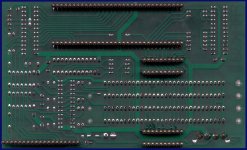 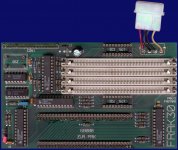 PAK-68/3-030: 68030 Accelerator for Amiga and Macintosh 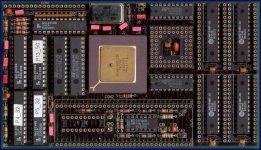 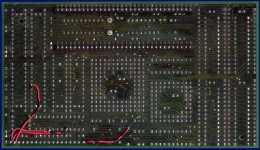 photo credit: http://amiga.resource.cx/exp/pak3 | |
| Posted by: Trash80toHP_Mini on 2018-01-26 21:21:50 I found this one in the attachments I've posted somewhere in the lost threads: View attachment 2940 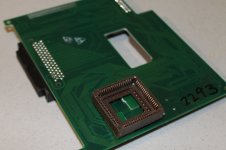 It's as simple as it gets, looks like it's set up for the Classic? | |
| Posted by: techknight on 2018-01-28 08:17:31 Looks that way, and it has the EC variant of the 030 which means it lacks the MMU. | |
| Posted by: Trash80toHP_Mini on 2018-01-28 08:37:06 The one I have on its way is the: MC68030FE33B QFP-132 ENHANCED 32-BIT MICROPROCESSOR Haven't found a datasheet, just the generic (humongous) 68030 Manuals Noticed that it has a 25MHz crystal and was hoping it was a 25MHz board given the 25MHz CPU. EvilCapatalist reports his board having the same 25 MHz oscillator, but running at only 16MHz? Looks like I'll be ordering a 50MHz Crystal can for my (tentative IIfx) 33MHz trials. I'm thinking my precious proc will be safe, let me know if it's at risk? The more I think about it, the more I think this project is directly applicable to a Luggable accelerator. I was shouted down in a previous thread where I had suggested such. I haven't got a backlit one, they seem to do some strange things and my spare board is from the original anyway. Have you got a luggable board for experimentation? | |
| Posted by: Trash80toHP_Mini on 2018-01-28 08:53:09 Looks like this insanity will be branching off into Performer schematic development/33MHz SE/Plus accelerator project and Luggable development project topics. This one has been tangentially diluted and Performer schematic development is the first step anyway. Chunking it seems the way to goI need to figure out how do read and create "real" schematics in a PCB layout process. Blech! :mellow: | |
| Posted by: EvilCapitalist on 2018-01-28 09:07:44 Took a few better pictures of my Performer: 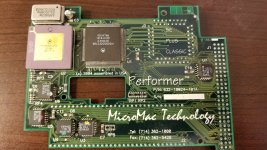 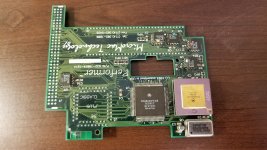 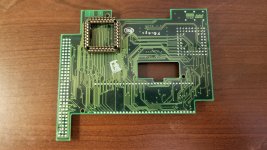 And here's how it shows up under Apple Personal Diagnostics. Despite having a 25MHz oscillator it's running at ~17MHz. 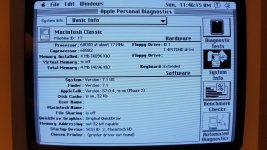 | |
| Posted by: Trash80toHP_Mini on 2018-01-28 09:12:28 SWEET! Now we're definitely off into a dedicated topic! Between yours, mine and Alaska's we've got all three interfaces implemented. | |
| Posted by: techknight on 2018-01-28 09:15:00 C3 has gotta go though. shame shame shame ;-) | |
| Posted by: Trash80toHP_Mini on 2018-01-28 09:18:43 ????? Off to work and guest status. :/ | |
| < 3 > |