68kMLA Classic Interface
This is a version of the 68kMLA forums for viewing on your favorite old mac. Visitors on modern platforms may prefer the main site.
| Click here to select a new forum. | |
| Compact Mac Power Meter Tool. :-) | |
| Posted by: MJ313 on 2015-02-02 09:36:53 MIT went 10-1 this year. That's one helluva fight song there. | |
| Posted by: techknight on 2015-02-02 10:09:45 Well I am not a sports fanatic, I dont watch it at all so i dunno. lol. | |
| Posted by: MJ313 on 2015-02-02 10:32:32 lol, I just wanted to feel like I knew something that you all didn't, which never happens around here. lol | |
| Posted by: uniserver on 2015-02-02 10:39:46 steve is kind of a humble dude. | |
| Posted by: bigmessowires on 2015-02-02 12:35:53 Let me know if you get that converter board made. I just submitted some identically-sized boards to OSHPark: $6 shipped for three copies. Hard to beat that! | |
| Posted by: uniserver on 2015-02-02 15:43:32 ok maybe next weekend i will log into smart prototyping.com might get like 50 made up. it sure is a beauty 🙂 | |
| Posted by: uniserver on 2015-02-02 15:46:20 id like to make an half size version of your floppy emu, for hd 20 only. i am going to experiment with Mike Mcmasters SCSI2SD and mod it to run from termination power. so it can be bus powered. pretty excited about that!!!!!! | |
| Posted by: techknight on 2015-02-02 16:07:02 Hey uni, with the mac plus you can add the termination diode in its little spot on the PCB too 😉 | |
| Posted by: uniserver on 2015-02-02 16:27:29 sweet man!! haha yeah because that is the only mac that doesn't supply term power. | |
| Posted by: techknight on 2015-02-02 17:15:54 Yup, and the PCB at least the versions I saw, has a spot for the diode but its un-populated. Once you populate a diode in there, boom you have termination power. | |
| Posted by: CC_333 on 2015-02-03 08:49:38 I wonder why termination power on the Plus would be deigned in, but left unimplemented like that? c | |
| Posted by: techknight on 2015-02-03 15:02:48 Good question... Its also a 1985 board, so it could be a later version but they didnt populate the diode. I dont know why. | |
| Posted by: unity on 2015-02-03 21:19:24 Mine came in today from Uni - time to give it a test drive. I know I could have made one cheaper, but its just nice to not have to do all the work sometimes! 😀 Thanks man! | |
| Posted by: uniserver on 2015-02-03 22:29:39 yeah now you gotta get over to bmow and buy a Plus128k 512k rom kit 🙂 | |
| Posted by: unity on 2015-02-12 16:29:56 Because I can. 🙂 lol 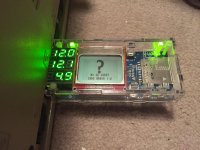 | |
| Posted by: uniserver on 2015-02-12 16:52:23 I like! | |
| Posted by: techknight on 2015-02-12 16:54:54 oooo Now we are talking!! And actually, with a slight redesign on the floppy emulator, and using the internal ADC reference of the AVR and some resistor-dividers, technically the atmel can monitor voltage supply and report it to the LCD. | |
| Posted by: bigmessowires on 2015-02-12 18:15:15 Mmm… glowy green electronics. [^] | |
| Posted by: bigmessowires on 2015-02-14 17:42:34 I got back the boards for the two DB-19 substitutes, and put them together today. Both versions use pins sticking out of a PCB, and a couple of rectangular LEDs as mechanical guides. Then there's an IDC-20 connector on the other side of the PCB, where you can attach a cable. Version A is based on a modification of Uniserver's idea, and uses 0.1" header split up into a few unevenly spaced sections. The DB-19 pin spacing is close to 0.1", but not exact, so the header pins end up getting kind of bent. That's not great, but this version is pretty cheap and easy to build. Version B uses 19 individual D-SUB crimp pins. The spacing is perfect to match the DB-19 female port. But it's kind of a bitch to build this version, since you have to stuff 19 pins one at a time, and use a female port as a jig, and then cut off the crimp section of each pin when you're done. And the crimp pins are a lot more expensive than regular 0.1 inch male header. Both versions seems to work just fine. I ran a Floppy Emu through some exercises on a couple of different Macs, with both versions of this board. There were no problems, and the connector stayed firmly in the socket. I think I'm going to make another revision, that's a tweak of the version A shown here. But instead of splitting up the 0.1 inch header as 5-5 and 5-4, I'll split it as 3-4-3 and 3-3-3. That will be slightly more work to assemble, but will result in less pin bending. Photos below, version A on right, version B on left: 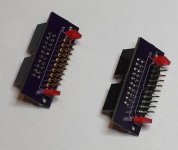 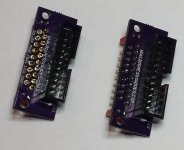 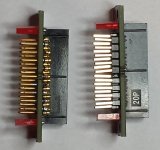 | |
| Posted by: uniserver on 2015-02-14 17:48:46 so i just got my single row headers from china. what if you just cut a bunch of individual pins of header, and just had them all properly spaced by the pcb? you need to make the LED's light. i'm sure it wouldn't be that hard. | |
| < 3 > |