68kMLA Classic Interface
This is a version of the 68kMLA forums for viewing on your favorite old mac. Visitors on modern platforms may prefer the main site.
| Click here to select a new forum. | |
| HD SCSI for PowerMac 7600 | |
Posted by: indibil on 2023-12-06 05:25:17Max is @max1zzz on these fora.Okay, I'll contact him if plan A doesn't work. I tell you news. I attach HD photos that I bought. If you look at the label, it includes the text LVD/SE. So this HD will allow me to terminate the SCSI chain? Should it have a jumper to activate it or is it already activated by default? I will appreciate instructions on how I should configure the HD, my intention is to install OS7.6 and OS8 on it, in two partitions. Since I have already bought the HD and the adapter, I will try first, otherwise I will contact MAX. | |
Posted by: Phipli on 2023-12-06 05:49:19So this HD will allow me to terminate the SCSI chain?No, SE stands for Single Ended. It doesn't mean the disk has built in termination but is to do with how the data signals are sent electrically. Early SCSI was all SE, and a newer disk with SE means it is backwards compatible in that specific sense. Should it have a jumper to activate it or is it already activated by default?SE usually needs a jumper fitting to enable, but you'll want to grab the manual for the hard disk if it doesn't say on the label. I will appreciate instructions on how I should configure the HD, my intention is to install OS7.6 and OS8 on it, in two partitions.It varies depending on the disk sorry. The manual will help you. You'll want your disk terminated, and to set a scsi ID (on the adapter). The adapter will come with instructions, be warned the last one of those I bought came with a jumper shorting the LED output so you MUST check the jumpers before powering it up. | |
Posted by: indibil on 2023-12-06 22:32:39No, SE stands for Single Ended. It doesn't mean the disk has built in termination but is to do with how the data signals are sent electrically. Early SCSI was all SE, and a newer disk with SE means it is backwards compatible in that specific sense.Okay, thank you very much. When I have the material I will carry out tests and tell you my results, although I am afraid I will have to buy the MAX adapter... Do you have photos of this adapter? 🙂 | |
| Posted by: indibil on 2024-01-02 04:30:11 Hello, today I received the adapter. I have start with BlueSCSI 7.6 Install CD Image. Well, it seems that it doesn't work, it recognizes the bus and the ID, but it gives me this message. Is it because of the termination? What is "force single ended" option in the hard drive? it makes the same result, not supported. I'm going to have to buy the good adapter. 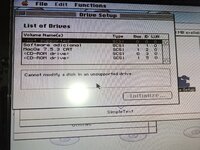 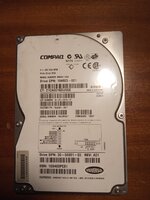 | |
Posted by: Phipli on 2024-01-02 04:31:33Hello, today I received the adapter. Well, it seems that it doesn't work, it recognizes the bus and the ID, but it gives me this message. Is it because of the termination?Not supported is fine, use the cracked version of the formatting tool... Give me a sec, I'll find a link. | |
Posted by: Phipli on 2024-01-02 04:37:50Not supported is fine, use the cracked version of the formatting tool... Give me a sec, I'll find a link. Find attached or for info: 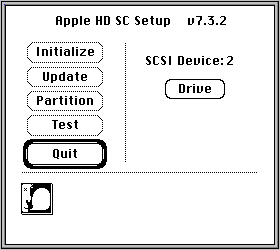
Format Any Hard Drive for Older Macs with Patched Apple Tools - Low End MacWith these patches and tips, you’ll never again need to use an unreliable, inconvenient third-party hard disk driver to format a hard drive for your Mac. Apple HD SC Setup and Drive Setup are the standard tools that everyone has used to prepare vintage Macintosh hard drives. They’re not as...
 lowendmac.com
| |
| Posted by: indibil on 2024-01-02 05:48:34 Thank you! I'm going to try it and tell you! P.S. Is it possible that on the 7600 the termination is in the CDROM unit? | |
Posted by: Phipli on 2024-01-02 05:51:40P.S. Is it possible that on the 7600 the termination is in the CDROM unit?Possibly, but if it is it will only be terminating 8 of the data lines on the disk. The disk or adapter needs to be terminating the rest. | |
Posted by: Daniël on 2024-01-02 05:55:37Possibly, but if it is it will only be terminating 8 of the data lines on the disk. The disk or adapter needs to be terminating the rest.This drive may be one of the exceptions of wide disks working with only narrow termination applied. If it's showing up, and works reliably after formatting, it pretty much confirms that. A handful of U160 drives, and very few U320 drives, can work without the full bus terminated. Why some do and some don't, I really can't tell. I have Seagate 2.5" U320 Savvios (IBM eServer branded) that work with the el cheapo adapter on a narrow terminated bus, for example. | |
Posted by: Phipli on 2024-01-02 05:58:47This drive may be one of the exceptions of wide disks working with only narrow termination applied. If it's showing up, and works reliably after formatting, it pretty much confirms that. A handful of U160 drives, and very few U320 drives, can work without the full bus terminated. Why some do and some don't, I really can't tell.Yes, that's what I was saying, in that case the disk would be terminating the rest of the bus, or just not care. What I was saying was that the CD isn't the reason the setup is working as it is only terminating some of the bus. | |
| Posted by: indibil on 2024-01-02 09:12:22 Bad news, with the patched tool it shows "no disk" at Bus 0, ID 0  | |
| Posted by: indibil on 2025-04-09 09:12:35 Hi, let me revive this post. Shortly after those attempts, the PM7600 stopped booting. When I press the button, the LED lights up, but no chime, no image, or anything. If I press the button again, it immediately shuts off. It's been sitting idle for a long time waiting to recap the PSU, because I haven't changed anything since the last time it booted up. Today I recap the PSU, but after installing it, I get the same result: no chime, no image, no boot. Checking the RAM modules, I saw a single slot at the top, and when I checked its label, I see it says SIMM ROM. Does this model need a SIMM ROM? And if so, how did I get it working until then? 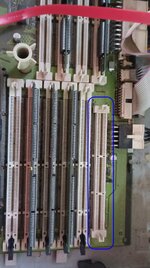 | |
| Posted by: chelseayr on 2025-04-09 14:10:26 I could be wrong but as far as I recall the 7xxx-9xxx series or therefore somehow had a rom slot as much as the rom was already actively onboard itself, the slot itself probably is some troubleshooting leftover that was retained in production for some apparent reason (on the other hand the 6xxx series did very much need a rom simm, again afaik!) | |
| Posted by: finkmac on 2025-04-09 14:47:00 it shouldn't need a ROM SIMM unless you're missing these 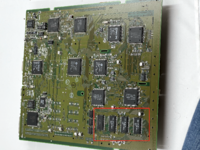 moreover... it booted fine before, did it not? you wouldn't have got that far if it require a ROM SIMM. | |
| Posted by: chelseayr on 2025-04-09 16:41:52 thanks @finkmac I was sure I recall the rom slot being always empty under normal conditions (even then I only just now remembered something else, is this still the same story for the few nubus/pds-not-pci board in the same number range?) | |
| Posted by: indibil on 2025-04-09 21:32:54 Okay, thanks a lot!!! I've ruled out any other possible symptoms of the problem. I'll keep investigating! 🙂 | |
| < 2 |