68kMLA Classic Interface
This is a version of the 68kMLA forums for viewing on your favorite old mac. Visitors on modern platforms may prefer the main site.
| Click here to select a new forum. | |
| New to me PB180...it's dead Jim... | |
| Posted by: SuperSVGA on 2023-06-13 16:31:18 The Powerbook will technically run without that diode. I think that's just for reverse polarity protection. | |
| Posted by: at0z on 2023-06-13 16:57:10 Hmm well one of those is not like the other. I wasn’t paying attention and should have measured the package. Rookie mistake. 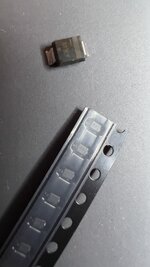 | |
| Posted by: desertrout on 2023-06-13 20:16:53 oh snap - I didn't think to take a measurement before linking 😳 | |
| Posted by: twelvetone12 on 2023-06-14 07:47:51 How big are the pads? Probably you can fit it with a generous blob of solder. | |
Posted by: desertrout on 2023-06-14 08:44:09How big are the pads? Probably you can fit it with a generous blob of solder.Yeah, or some other means of extending the leads (or pads)... BUT - I'm really curious about the actual specs of the original part. In addition to neglecting to check the package size, I should have also looked more closely at the diode's specs, as the 13V rating seems high; I'd think it should be closer to 8V if it's for protection (at least over-voltage). This begs all kinds of questions about the marking, since I can't find any other reference for 'KW' than DDZ13B, and I also can't find a zener with DDZ13B's specs in a SMB gull wing package. It very well may be the device code is a coincidence. In the meantime @SuperSVGA is correct in that you can run the machine without it - even if just to test. | |
Posted by: SuperSVGA on 2023-06-14 08:59:29I'd think it should be closer to 8V if it's for protection (at least over-voltage).It's more likely for reverse polarity protection. Except now it's failed and current is flowing in both directions. | |
| Posted by: SuperSVGA on 2023-06-14 13:29:24 I pulled one out to test, looks like a 13V Zener diode somewhere around the SMB or DO-215AA package size. | |
Posted by: at0z on 2023-06-14 13:29:45It's more likely for reverse polarity protection. Except now it's failed and current is flowing in both directions.Removed from the board it tests conductive in both directions... | |
Posted by: at0z on 2023-06-14 13:45:14Removed from the board it tests conductive in both directions... It's more likely for reverse polarity protection. Except now it's failed and current is flowing in both directions.Well funny enough the guy I got it from didn't have a power brick so I'm wondering if someone tried to power it from a third party adaptor in which the polarity was wrong and that's what killed it. | |
Posted by: at0z on 2023-06-14 13:45:54I pulled one out to test, looks like a 13V Zener diode somewhere around the SMB or DO-215AA package size.I can only find the DDZ13BS in the super tiny packages.... | |
Posted by: at0z on 2023-06-14 13:46:36Yeah, or some other means of extending the leads (or pads)...Yes, all I had to go on was the KW marking.... | |
Posted by: at0z on 2023-06-14 13:51:50How big are the pads? Probably you can fit it with a generous blob of solder.now why didn't I think of that... | |
Posted by: SuperSVGA on 2023-06-14 14:22:20I can only find the DDZ13BS in the super tiny packages....1SMB5928 probably works fine, I think it's J-lead but should fit. The gull wing style like the original seems harder to find. | |
| Posted by: MacUp72 on 2023-06-14 23:15:12 how does your diode read? If the zener diode reads low resistances in both directions, this is a sign that the diode is shorted. a guy solved the problem with his pb180 not turning on by reclacing the Zener Diode, iFixit. datasheet of the DDZ13B: if it difficult to solder the tiny diode to the pads: solder an additional wire to the end of it, then solder one end of the diode down to the board and after that just connect the end of the wire to the other pad. (desertrout also suggested this). power brick, I didnt have an original brick with my pb 160, only a replacement unit, it did output around 10V at 2A ( altough it read only 5V on the label), it started fine. | |
Posted by: desertrout on 2023-06-15 06:56:46now why didn't I think of that...That seems to be the way to go... based on @SuperSVGA, the zener you bought is the correct specs, just needs to 'made' to fit (and @MacUp72's like supports this). | |
| Posted by: PB170 on 2023-06-15 07:48:39 I’ve never heard of this being a problem, but I’m throwing it in here just in case. I’ve noticed on my PowerBook 170 that if any of the keys on the keyboard are pressed when the power button is pressed, nothing happens. Release the key and the computer starts up. I suppose, if any of the keys are stuck it would make the computer appear dead. Might be worth checking out. | |
Posted by: Phipli on 2023-06-15 07:51:43Yeah, -ish... to clarify, the 140/145/145B and 170 share the same motherboard, and the 160/165 and 180 share a revised motherboard... the power circuit looks a little simplified, but it looks like most of the major components are still there in a recognizable / similarish configuration.The 145B is slightly different - I think the FPU footprint got deleted and extra RAM added? Edit - ah sorry, logic board - I was thinking the CPU board. | |
| Posted by: at0z on 2023-06-17 12:10:47 Yay that solved it. Replacing the Zener and the tantalum cap next to it (it have me an inconsistent read) brought it back to life. Screen appears to be undamaged, no missing lines and no tunnel vision I can see. Of course I am now getting the flashing question mark because I can't hear the HD spinning or even coughing so I have to assume it died. I don't have any donor spares and I guess most people have replaced with a SCSIHD equivalent ? I've got a BlueSCSI built and waiting to jump into something. Is that the general consensus ? Has anybody 3D printed a mount for such a thing or are they resorting to engineering level use of duct tape ? I really suspect someone didn't have the right power brick and blew it with the wrong polarity. | |
| Posted by: 3lectr1cPPC on 2023-06-17 13:28:46 Nice! Good fix. I’m pretty sure the PowerBook BlueSCSIs come with a mount designed for the 100 series already. I just got one in for my 170 as a matter of fact so I’ll be setting that up tonight probably. Got to solder it all up. | |
| Posted by: at0z on 2023-06-17 13:51:34 I got the regular one. Maybe I need the PowerBook version. Is bluescsci still the one to go for? | |
| < 2 > |