68kMLA Classic Interface
This is a version of the 68kMLA forums for viewing on your favorite old mac. Visitors on modern platforms may prefer the main site.
| Click here to select a new forum. | |
| Lobos board (Strange Apple ROM) | |
Posted by: MacKilRoy on 2022-01-22 06:41:20I wonder if it could be a prototype ROM board name, and being such, it was too insignificant to record it? So instead of a whole computer being named Lobos, it was just this ROM simm? I’m thinking maybe it could be a Quadra ROM? | |
Posted by: Johnnya101 on 2022-01-22 07:26:06I’m thinking maybe it could be a Quadra ROM?I was too, timeframe would be right. It would have to be the 950 which was 1992? | |
Posted by: Performa450 on 2022-01-22 09:25:44I was too, timeframe would be right. It would have to be the 950 which was 1992?I was thinking that too - could also be a 1993 machine, but pre-release, so 610/650/800 or a workgroup server too. Or, it could have been erased, but lets hope not! | |
| Posted by: dougg3 on 2022-01-22 10:48:22 Fascinating! Here are some things that I notice about the ROM SIMM's pinout based on the picture:
I like the idea of trying to boot an SE/30 or II series Mac with it. Some (but not all) of the newer Quadra ROMs are also capable of booting the older II series machines and SE/30. So if you can get it booted, you could read out the contents with CopyRoms or a similar utility. | |
Posted by: Performa450 on 2022-01-22 14:54:32Fascinating! Here are some things that I notice about the ROM SIMM's pinout based on the picture:Thanks very much for the extra info - there are capacitors on the back, you can see a low res picture from the seller here: https://www.worthpoint.com/worthopedia/apple-ap1950-01-lobos-simm-board-64-3243494164 I'll post a high res picture of the back either tomorrow or Monday, and hopefully get to checking in the AITV box then. | |
Posted by: dougg3 on 2022-01-22 15:11:14you can see a low res picture from the seller here: https://www.worthpoint.com/worthopedia/apple-ap1950-01-lobos-simm-board-64-3243494164 Ooh thanks! I will definitely be interested in seeing your high res back pic. Based on that low res picture, it looks like SIMM pin 2 = VPP and pin 3 is WE. So I might be wrong about pin 13. Pin 13 may just be normal 5V. The higher res pic should give us a little more clarity. | |
Posted by: mg.man on 2022-01-22 16:22:56Hopefully I can find someone local with a compatible machine.I may have missed it... but what counts as "local"? | |
| Posted by: CC_333 on 2022-01-24 10:58:17 I have a programmer (one of the originals that @dougg3 produced back in 2013 or so), but I'm in the US, so that's probably of little help to those in the UK and elsewhere... c | |
Posted by: Performa450 on 2022-01-24 11:41:18I may have missed it... but what counts as "local"?I'm down in Kent, so around there really. | |
Posted by: Performa450 on 2022-01-24 11:42:30Thanks very much for the extra info - there are capacitors on the back, you can see a low res picture from the seller here: https://www.worthpoint.com/worthopedia/apple-ap1950-01-lobos-simm-board-64-3243494164 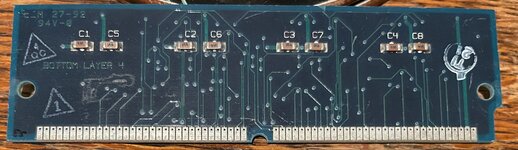 | |
| Posted by: dougg3 on 2022-01-24 21:09:02 Awesome picture! Thanks for sharing. Unfortunately, that stamp on the right is covering up some of the vias and traces I'm trying to look at. Nevertheless, I'm pretty darn sure that SIMM pin 2 = VPP and pin 3 = WE. I was wrong about pin 13 -- it's going to one of the inner layers, likely +5V. Looks like C5, C6, C7, and C8 are for VPP, and C1, C2, C3, and C4 are likely for +5V. I haven't checked every trace, but it looks to be the same 64-pin ROM SIMM pinout used by everything from the SE/30 onward. | |
Posted by: mg.man on 2022-01-25 11:25:21I'm down in KentWell, at least that's UK... 😀 I have a variety of Macs I could pop this in and see what happens if you're interested. I also recently downloaded a variety of ROM dumpers to get the code off my StarMax - which resulted in a working ROM file for SheepShaver... Happy to attempt a download as well if you want. | |
Posted by: Performa450 on 2022-01-25 11:37:30Awesome picture! Thanks for sharing. Unfortunately, that stamp on the right is covering up some of the vias and traces I'm trying to look at. Nevertheless, I'm pretty darn sure that SIMM pin 2 = VPP and pin 3 = WE. I was wrong about pin 13 -- it's going to one of the inner layers, likely +5V.It looks like this through a loupe if it helps clear things up: 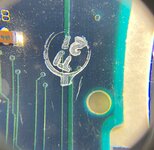 | |
Posted by: Performa450 on 2022-01-25 13:08:48Well, at least that's UK... 😀 I have a variety of Macs I could pop this in and see what happens if you're interested. I also recently downloaded a variety of ROM dumpers to get the code off my StarMax - which resulted in a working ROM file for SheepShaver... Happy to attempt a download as well if you want.Thanks! | |
| Posted by: dougg3 on 2022-01-25 18:16:45 Thanks for the loupe view! That confirms exactly what I said about the pinout in my previous post. | |
| Posted by: Tarantulas on 2023-02-25 13:26:48 It’s been over a year… what did it end up being a ROM for? | |
Posted by: switch998 on 2023-06-01 13:19:59It’s been over a year… what did it end up being a ROM for? 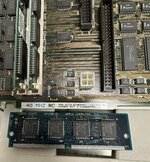 I found one in my EVT Quadra 800. I would guess both are from a Q800, since the date codes on the other ROM look the same. But maybe someone else can chime in if this style of simm was re-used in other macs. | |
| Posted by: cheesestraws on 2023-06-01 13:56:28 That would make sense! | |
| Posted by: Phipli on 2023-06-01 13:59:26 @switch998 I... would love a copy of a 40MHz Wombat ROM. The stock ones do 40MHz, but the RAM timings are marginal... Does the machine boot? | |
Posted by: switch998 on 2023-06-01 15:55:39@switch998It does, however I doubt there's any difference. I just checked and there is a 33mhz CPU installed and the oscillator was changed. I have it currently disassembled awaiting a 40mhz CPU. Once I get it I will try to dump the ROM. One hardware difference I can see is that the djMEMC is a different part number than usual, it is VY16568-2 instead of just VY16568, but that may just be denoting the revision. | |
| < 2 > |