68kMLA Classic Interface
This is a version of the 68kMLA forums for viewing on your favorite old mac. Visitors on modern platforms may prefer the main site.
| Click here to select a new forum. | |
| 2.5" SCSI SSD Project | |
| Posted by: techknight on 2011-02-24 10:44:52 I updated the wiki page to reflect this project as well... | |
| Posted by: register on 2011-02-24 14:45:17 I appreciate the project as well, techknight, thank you a lot in putting that much effort into the solution. The artmix thing seems not to be available anymore and other much more expensive solutions are out of stock and not likely to go into production again. So what you are doing is exactly what we need and includes an option to derive further solutions on demand. Again: I love such project and also will happily buy a working board as long as the price is not much more than for the artmix device. Thank you for spending your time and please go on! 🙂 | |
| Posted by: trag on 2011-02-24 15:00:39 I think it's a cool project too. At first I kind of wondered what the point was, given the cards available from Acard, but I had not been to their site in a while. Wow! Their prices have gone up by a factor of 2.5 in the last five years or so and a lot of stuff just isn't available any more. What was $70 is now $200. Eeeek! Definitely worth having a homebrew solution at those prices. What I would really like to see is a requirements document, detailing what signals are expected from each direction and how they must be translated. From that kind of thing, one could generate whatever hardware solution is the most interesting to the person doing the work. | |
| Posted by: Trash80toHP_Mini on 2011-02-24 17:55:35 Instead of Thru-Hole or standard SMD connectors, if you can use a thin enough board, it's possible to use Thru-Hole Headers as "Edge Card Connectors." There are standard "adapter cards" that use this method. In this way you can avoid the problem of passing traces between teeny tiny pads, using VIAs well away from congestion to get the correct signals to the correct pins.   With a thin enough "connector PCB" you could probably use the same method with the smaller 2.5" SCSI pins. If you're doing a two board system, it might just work out. If you (or another comrade) can find the edge-mount pins to match the female connector used for the 2.5" laptop drive adapter in the lower pic, they'll probably have the proper "offset" built in for straddling standard thickness FRP PCB Material. Just a thought! }🙂 | |
| Posted by: techknight on 2011-02-24 18:11:30 the thickness of the PCB depends on whos manufacturing it i guess, I havent picked one final yet, but i have been leaning towards olimex. prices seem reasonable. im sure there are cheaper places. Also keep in mind that this project is open source as well, under the GPL. So once a final produced board is completed, you can do modifications to your hearts content. 🙂 as far as SCSI goes, command/data structure is in teh form of CDB commands. like Read(6), Read(10), Inquiry, etc etc etc. Whats expected/inside the "Read" and "write" commands, depends highly upon the the driver using the SCSI bus. as SCSI can work with anything. only thing is mac has native, is a disk driver. so it expects LBA/sector data from the Read/Write commands. and HDD LBA size, etc from the Inquiry commands. The possibility of what can be done with SCSI is endless. even though its a slow buss on these old machines, You can use SCSI as an "encapsulation" mechanism bus. So then all you need is a processor at the tail end of the SCSI just "decaps" the capped SCSI CDBs, and they become new commands, which could be commands to drive, say a Wi-Fi chipset. or a realtek LAN chipset. So in a nutshell, the a "specific" driver could target the SCSI bus, and encapsulate a command inside the SCSI system. the command would get de-capsulated at the target device, back into a regular command, as if the hardware were connected direct to the driver 🙂 | |
| Posted by: Trash80toHP_Mini on 2011-02-24 21:14:35 It's midnight, I'm tired and can barely see straight, but I put digital calipers to a 40 pin PowerBook Female Header Connector on a flex circuit. Dunno what 'Book or Drive Type, but they're definitely 2 mm spacing and it looks & feels right to use these:  from here: http://www.engineeringlab.com/jumpers-cables-headers.html to solder the Tails to Edge Connector Pads on either side of a standard FRP PCB to get your "plug" for a PowerBook Flex Circuit HDD Cable. jt, signing off to get some sle . . . zzzzzzzzzzzzzzzzzzzzzzzzzzz . . . :scrambled: | |
Posted by: CJ_Miller on 2011-02-25 06:09:09I may have jumped the gun a little bit in my last post as well, because its hard to read peoples emotions/feelings through a keyboard ;-)You think that's bad... I am probably a high-functioning autistic, or nearly so. People don't find me much easier to read in person! And then if I try to compensate by offering a detailed explanation of my state of mind for them to work with, they look even more perplexed and worried! Many have even told me that I am more expressive in text than in person. Ah yes people are weird. No worries! | |
Posted by: trag on 2011-02-25 09:29:13the thickness of the PCB depends on whos manufacturing it i guess, I havent picked one final yet, but i have been leaning towards olimex. prices seem reasonable.These days, "standard" FR4 circuit board is .063" thick. If you want something else, e.g. .050" for 30 pin SIMMs or old ROM modules, then the cost usually goes up. And it's not really so much that the price goes up. It's more that there's normally priced PCB fabrication and then there are all the specials and deals that are available. And virtually all of the specials or deal insist that you take "standard" .063" thick board. So, for example, you can get .032" or even .020" thick board but you probably can't find as good of a price on it. The thinner board might be useful in your application where vertical space is extremely limited and, presumably, the board will be screwed to the bottom of a hard drive and so not allowed to flex much. | |
| Posted by: techknight on 2011-03-01 19:33:01 been some long days at work, so ive not had much time. I did manage to get the SCSI connector footprint added in, and some more routing and netting done. 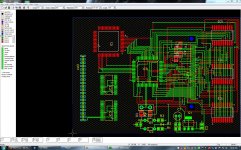 | |
| Posted by: techknight on 2011-03-01 20:33:36 awwwwwwwwwww maaaannnn........... I am gonna have to start ALL OVER AGAIN... I just relized something. the compact flash card is going to be too long. itll hang over the edge of the board, and it wont fit into a 2.5 drive bay :-( NOT GOOD.... | |
| Posted by: Trash80toHP_Mini on 2011-03-01 20:53:41 I feel for ya! :disapprove: NOT GOOD!  | |
| Posted by: techknight on 2011-03-01 21:20:13 Well i can save my design if i go to 2 boards. just sandwich them together using board-to-board headers. So, i just deleted the SCSI transciever ICs, the SCSI PIA IC, and the connector off this board. and just stuck a big fat 20 pin header there, and moved the compact flash slot, its wiring and MCU back to just clear the CF card. adds an extra 2mm roughly as well. But pushing the CF card back has prompted me to go to a 2-board design. sucks, but oh well. as long as it works. I was trying to avoid this because having 2 boards drives the cost up. But it does make it easier for me to lay everything out. and when assembled, i solder the 2 boards together via the header, and it becomes one. | |
| Posted by: Trash80toHP_Mini on 2011-03-02 05:14:01 How would using two single row Right Angle Headers on the inner sides of the two boards work for your cable connect? This would solve the between pad routing problem nicely. You could then splay the traces out to a more workable OC width for inter-board connect. Are you using Zeners to damp each connection to the HDD cable? I once used the ground and signal legs of each Zener on the EdgeCard "pads" of an ISA Card Prototype to connect the two sides of a homebrew/etched PCB together in lieu of plated thru-holes. Discrete, thru-hole components ROCK!! If you use the extra real estate creatively, the money spent on doubling the PCB area can save assembly time, which costs a lot more! [😉] ]'> Great job, keep it up! :approve: | |
| Posted by: techknight on 2011-03-02 18:06:54 Well, I dont need zeners. I am using special purpose transcievers, the 75LVDM977, which i think should work just as-is Anyway, as far as routing room, cutting the connector in half and use it between the two board would save routing room, possibly, but since im gonna have to use 2 boards anyway, it shouldnt matter. | |
| Posted by: Trash80toHP_Mini on 2011-03-02 19:03:54 Using RA Headers on each of your boards is not about saving routing room, per se, it's about eliminating the necessity for inter-pad routing to get traces to the pads on the card edge side of the connector. I think you'd mentioned that you'd like to avoid that due to the ridiculously tight size limitations. | |
| Posted by: techknight on 2011-03-02 20:38:21 aahhhh ok i see what your saying now. neat idea. | |
| Posted by: Trash80toHP_Mini on 2011-03-03 03:57:04 [😉] ]'> | |
Posted by: insaneboy on 2011-03-03 11:55:19I just relized something. the compact flash card is going to be too long. itll hang over the edge of the board, and it wont fit into a 2.5 drive bay :-( NOT GOOD....oops! Looking at the early pictures I thought the card was going to insert the other way around and be in the middle of the board... | |
| Posted by: techknight on 2011-03-03 15:52:48 yea, i could have done it that way. hehe. Oh well, Ill just make a 2-board setup. I just hope it dont cost way too much. I am probably going to make at least 10 of them, I dont know if i need more than that. maybe ill do a final tally once everything is done. That way, i can estimate how much its gonna cost me for 10 and divide it down. it all depends on who i get to make the boards. Any suggestions? I tried olimex but thier DRC is too restrictive for my vias on my design. | |
| Posted by: Trash80toHP_Mini on 2011-03-03 17:45:00 Are you talking a pre-production run of ten Rev.0 units for testing and then ramping up for higher demand for Rev.1? :?: I know I want several! :approve: [😀] ]'> | |
| < 2 > |