68kMLA Classic Interface
This is a version of the 68kMLA forums for viewing on your favorite old mac. Visitors on modern platforms may prefer the main site.
| Click here to select a new forum. | |
| SE/30 Not Recognizing Disks In Internally-Connected Drives | |
| Posted by: Turaiel on 2017-07-28 17:10:27 I'm so close to being finished with my SE/30 restoration. Initially, it had the 1.44 MB floppy drive connected internally. After fighting with it for weeks, I pulled my 800k drive out of its external enclosure and installed that in place of the 1.44 MB. Now, when I insert a disk I'm prompted to initialize it. I thought maybe the cable was the issue, but I swapped it with a known-good one and the problem continued. I know the drive works, and that the floppy disk is good, because everything works fine when I connect the drive with the cable from the external enclosure. Any ideas on that? | |
| Posted by: IlikeTech on 2017-07-28 18:40:41 I bet it is the bourns filter based on the symptoms. It is a 20 pin DIP part. The Apple part number is 115-0002. IlikeTech | |
| Posted by: Turaiel on 2017-07-28 19:41:51 I'm curious; what about the symptoms brought you to that conclusion? | |
| Posted by: IlikeTech on 2017-07-28 20:36:33 Just reading some things in the dead Mac scrolls. It would seem like the only thing that can cause that kind of problem? | |
| Posted by: Turaiel on 2017-07-29 19:04:24 From what I've read, the Bourns filter going bad generally causes an unresponsive gray screen on boot. In this case, the system does boot fully and if the system disk is removed, it will attempt to read from the internal and external floppy drives. The problem is just that it thinks that all disks on a drive connected to the internal port are uninitialized. | |
| Posted by: IlikeTech on 2017-07-29 19:45:59 Ok, I'll see if I can find anything else. SIWM? | |
| Posted by: techknight on 2017-07-30 14:31:32 Bourns filter on the SWIM will cause a "phantom drive problem", meaning it will ask you to format a disk in a drive that isnt even connected or present. Does it recognize external drives? or no drives at all?? If it doesnt see anything then maybe its time to look at the traces from the SWIM back to the BUS, and back to the floppy connector itself. Also, I am sure your aware, but I will say it anyway. You cant put an 800K drive in there, and expect it to read the 2-hole 1.44MB floppy diskettes. You have to use DS-DD disks with an 800K drive 😉 | |
| Posted by: Turaiel on 2017-07-30 15:19:19 It only fails to recognize disks in drives connected to the internal floppy header. The same 800k drive works externally. The original internal drive is a 1.44 MB drive, which just doesn't seem to work in general. However, if I plug THAT drive in externally, the head moves a little bit but the drive doesn't work at all. To summarize: 1.44 MB drive doesn't recognize disks internally or externally. Externally it spins slightly but doesn't react otherwise. 800k drive works perfectly externally, does not work internally. I am using 800k disks in both, and HD disks only in the 1.44 MB drive. 1.44 MB drive works better externally on my SE than my SE/30, but still cannot read disks. I've tested both drives using known-good cables and known-good disks. | |
| Posted by: techknight on 2017-07-30 17:01:49 if it works externally, and not internally then we have a bad trace between the connector and the SWIM. | |
| Posted by: Turaiel on 2017-07-30 17:51:48 I guess that wouldn't surprise me terribly. The board wasn't in great shape when I started the repairs; corrosion everywhere. Which chip is that so I can inspect it? | |
| Posted by: powermax on 2017-08-04 06:42:09 The SWIM chip on the SE/30 is located near the internal floppy connector J8. It's marked as 344S0061-A. | |
| Posted by: Turaiel on 2017-08-04 14:58:32 Thanks for pointing that out. I looked over the top and bottom of the board around this chip and I didn't find any obviously bad traces, but my electronics skill is minimal. I've attached some photos in case anyone can see anything that sticks out to them. 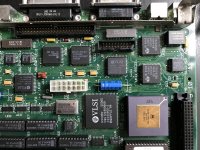 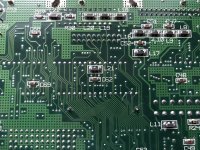 | |
| Posted by: techknight on 2017-08-04 15:29:14 Yea, I see a ton of scratched traces. You need to check each and every one of them. | |
Posted by: powermax on 2017-08-04 17:09:32Yea, I see a ton of scratched traces. You need to check each and every one of them.+ 1. Check everything in this area for broken/shorted traces. | |
| Posted by: powermax on 2017-08-04 17:25:39 It looks like your logic board has been recently recapped. I see three non-original tantalum caps to the left of the SWIM chip on your picture. I'd suggest to check them as well to ensure there is no shorted traces or bad solder joints... | |
| Posted by: powermax on 2017-08-04 17:29:09 Especially, the traces around C10 look like they were broken or shorted... | |
| Posted by: Turaiel on 2017-08-04 17:39:28 I did the capacitor replacements myself. Can traces be shorted if they aren't exposed on the surface? I'll have to check them more closely when I get back on Monday. Thanks! | |
| Posted by: Turaiel on 2017-08-10 20:46:52 I found that the things pointed out were most likely a combination of bad lighting and dust/cotton swab fibers. I've cleaned up the areas a bit, so here are some new pictures. I still can't find anything particularly worrisome. 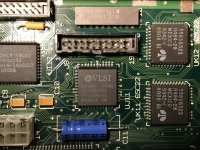 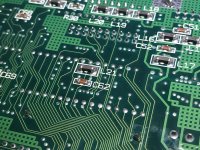 | |
| Posted by: techknight on 2017-08-11 15:08:12 Actually, the second picture clearly identifies you have quite a few cracked solder joints on the floppy connector itself. Try re soldering that connector and go at it again? | |
| 1 > |