68kMLA Classic Interface
This is a version of the 68kMLA forums for viewing on your favorite old mac. Visitors on modern platforms may prefer the main site.
| Click here to select a new forum. | |
| Transformers for homemade LocalTalk/PhoneNet dongles | |
| Posted by: Tashtari on 2024-03-26 06:12:25 This topic's been touched on in a handful of threads previously, but as far as I know, the question's never been settled. What kind of transformer (that you can buy new) would work for making a homemade LocalTalk/PhoneNet dongle? Inside AppleTalk (2nd ed, page A-6) gives the following specifications: 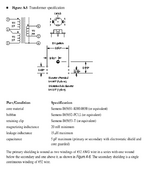 ...But I can't find anything matching them for sale. Trouble is that I don't really know which parameters have wiggle room in them and how much. Anyone have any expertise to lend to the subject? | |
| Posted by: olePigeon on 2024-03-26 11:17:06 I attempted to contribute to this discussion by spending about an hour trying to make a snarky AI generated image of an AppleTalk adapter as a Transformer toy, but I guess there aren't enough images for it to scrape. 🙁 | |
| Posted by: Reasons. on 2024-03-26 13:03:59 This may not be useful (I'm far from an expert on the technical side of things), but I know NeitherNet adapters don't ship with transformers and do work (though presumably they need external termination). | |
Posted by: Tashtari on 2024-03-26 13:09:59This may not be useful (I'm far from an expert on the technical side of things), but I know NeitherNet adapters don't ship with transformers and do work (though presumably they need external termination).Oh, interesting, I didn't know someone had productized it, but I'm guessing those basically use the CapNet schematic. That's a solution that's probably good enough for most use cases, but I'd really like to go the full way and use actual transformers if possible. | |
| Posted by: cheesestraws on 2024-03-26 13:20:07 I sometimes wonder if people who sell that kind of thing know why the decisions were made that they ignore. I wouldn't be able to look customers in the face if I were selling them that, so perhaps it's most charitable to assume ignorance. But I can't find anything matching them for sale. What specs are you finding? | |
| Posted by: robin-fo on 2024-03-26 13:26:27 I once discussed this topic with my (ex-)boss who is experienced electrical engineer; I believe he suggested to make the transformer myself. The 20mH specification is the tricky part when choosing a stock part. There are a few which come close, though... | |
| Posted by: robin-fo on 2024-03-26 13:28:39 Depending on the use case, some other solutions might also be interesting, like galvanic isolating transceiver chips. | |
| Posted by: cheesestraws on 2024-03-26 13:37:09 One thing to note is that the LocalTalk cabling system is extremely overspecced for what it actually carries, and I'm not sure why. But I am appallingly bad at analogue electronics and I do not know what slippage would be permissible... but I bet there is some. | |
| Posted by: NJRoadfan on 2024-03-26 13:48:04 Has anyone split apart a PhoneNet box to see what they used? I'm sure plenty of companies played fast and loose with the standard if it meant finding a cheaper part. | |
| Posted by: NJRoadfan on 2024-03-26 14:16:04 Says a 1:1 transformer is needed, but not much else specification-wise. Some USENET postings on it: https://groups.google.com/g/comp.sys.mac.hardware.misc/c/og1psm79-BU/m/ztt_qHJbFWYJ | |
Posted by: Tashtari on 2024-03-26 14:39:10Has anyone split apart a PhoneNet box to see what they used? I'm sure plenty of companies played fast and loose with the standard if it meant finding a cheaper part. 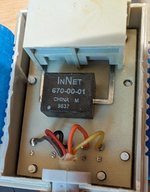 Maybe you'll have more luck than I did, but I could not find anything about the specs of this one... | |
| Posted by: ymk on 2024-03-26 15:02:35 This could be worth a try: | |
| Posted by: NJRoadfan on 2024-03-26 15:08:40 You are looking for a 1:1:1 winding transformer or transformer with double primary winding. I would check the inductance and other parameters of the part in the PhoneNet box with a meter. Chances are they aren't within Apple's official specs. | |
Posted by: Tashtari on 2024-03-26 15:33:05I would check the inductance and other parameters of the part in the PhoneNet box with a meter.Alas, my meter is limited to volts, amps, and ohms... | |
Posted by: cheesestraws on 2024-03-26 15:50:21Maybe you'll have more luck than I did, but I could not find anything about the specs of this one... pretty sure InNet ended up being bought by Bel, if that helps... | |
| Posted by: cheesestraws on 2024-03-26 15:55:42 ... is it just me, or does the Inside Appletalk chapter on the transformers not specify what frequency the capacitance and inductance are measured at? Also, now I come back to it again, the wording is weird. And looks descriptive. "The transformer is..." etc. That makes it even more unclear to me how much of that is requirement and how much is just "welp here's what we did". I was just looking at the specs for ordinary 10BaseT magnetics, and wondering whether one of those would do - the capacitance is rather high, which would make the resulting signal a bit less neat, but they are rated for 10mbit, so the edge sharpness can't be that much of a problem. Time to remember how to use ltspice? I wish I understood analogue crap | |
| Posted by: halkyardo on 2024-03-26 16:10:06 I just happened to have a PhoneNet adapter sitting on my bench (albeit an off-brand Interex one), so I cracked it open and traced it out. I have a few such adapters, they're rather nice in that they've got activity LEDs (labeled "TX" and "RX" but actually just wired in series 🤦♂️) and a built-in termination resistor controlled by a switch. According to my LCR meter of extremely dubious quality, the transformer measures about 500uH across both primary and secondary windings, with negligible (~1 ohm) series resistance. I also measure about 30-50pF between any of the transformer's terminals and its shield, which is connected to the shield on the Mac's serial port. 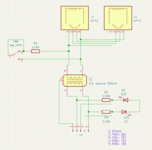 | |
Posted by: cheesestraws on 2024-03-26 16:21:02According to my LCR meter of extremely dubious quality, the transformer measures about 500uH across both primary and secondary windings, with negligible (~1 ohm) series resistance. I also measure about 30-50pF between any of the transformer's terminals and its shield, which is connected to the shield on the Mac's serial port. that looks more like the specs I would expect based on my brief and uninformed survey of ethernet isolation magnetics... | |
| Posted by: Tashtari on 2024-03-26 16:41:11 @halkyardo Thanks, this is great! Looking at Digikey, maybe this is a decent match? | |
| Posted by: NJRoadfan on 2024-03-26 16:48:59 That differs a bit from Apple's specs. They state two primary windings connected in series, maybe to boost output power? That's likely with their 3-pin cables. Phonenet was designed to be cheap, so lets just ignore the balanced RX/TX and use it to power pretty LEDs instead. Looks like the PhoneNet box matches what is on Page A-4 (one primary winding). So, what is the wiring on page A-6, A-7? | |
| 1 > |