68kMLA Classic Interface
This is a version of the 68kMLA forums for viewing on your favorite old mac. Visitors on modern platforms may prefer the main site.
| Click here to select a new forum. | |
| Dead SE/30 Power Supply (no fan, no voltages at floppy connector) | |
| Posted by: PacificState on 2022-01-10 21:19:19 I grabbed an SE/30 from Craigslist tonight which was sold as dead. Returning home, I found a couple of things: - The motherboard was actually in good shape, with no obvious major battery or capacitor leakage. That said, one of the vias by the battery (just one!) was green and corroded, although this is easy to fix. - The more major problem is that the machine doesn't power up at all - there's no fan activity, and I can't see any voltage at the floppy connector. Before I tear it all down - the power supply is made by Sony, and I can't seem to find any reference online to actually repairing it. I'm also assuming it's a switched model - is it fixable, or should I be hunting for a working unit? | |
| Posted by: joshc on 2022-01-11 00:36:29 The power supply probably needs recapping. The Sony CR-44 is a universal switching power supply. Or you can replace the internals of it with an ATX PSU and do a conversion (as the wiring does not match up). Also worth checking the fuse on the power supply, if it's blown then something else is wrong and will need to be fixed first. The caps needed for the Sony are listed here: 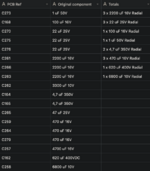 You can buy a kit from here, or alternatively buy from a parts supplier such as Mouser. Macintosh SE & SE/30 Power Supply: Sony CR-44 Cap Kit<p>Full cap kit for the Sony CR-44 power supply found in Macintosh SE and SE/30 computers, attached to the analog board.</p> <p><strong>Notes about this kit:</strong></p> <p>Original 620uF main filter cap will be replaced with a similar value, such as 6
 console5.com
I'd also check all the connector joints on the analog board, if the connector from the power supply to the AB has bad solder joints you won't get any power to the logic board. Check the voltages at the power connector on the logic board too with it switched on. | |
| Posted by: PacificState on 2022-01-11 11:42:23 Thanks! I've extracted the analog power and power supply and will look for cold joints. Initially, though, the internal fuse seems good though. Otherwise, does the power supply need a specific load to be tested in isolation, or will the rails come up without one? | |
| Posted by: Johnnya101 on 2022-01-11 11:59:16 Pretty sure you need a load, I think you need the flyback + CRT in? | |
| Posted by: joshc on 2022-01-11 12:31:41 I think that one needs load to do anything yeah. | |
| Posted by: PacificState on 2022-01-11 13:39:39 OK, it looks like the switch! Now to extract it and see if there's a suitable replacement... | |
| Posted by: joshc on 2022-01-11 13:45:02 Ah, good find! At least it's an easy fix, I'm pretty sure those are still made. | |
| Posted by: 8tto on 2022-01-11 14:41:16 You don’t need a load to test the PSU, but the voltages won’t be right until you do. @JDW have a nice video about it on YouTube. Much better if it’s just the switch, though 🙂 | |
| Posted by: aeberbach on 2022-01-11 15:00:38 The switch you need is made by Marquardt 1802.6123 - I bought some recently from Mouser Electronics. Appears to be the original part. | |
| Posted by: PacificState on 2022-01-12 09:15:10 Thanks! Switch on its way and I'll probably recap at the same time... | |
| Posted by: stansteph54 on 2022-10-13 06:56:06 Hi there, I hope I can use this thread... I've got exactly a same issue with a Mac Classic. No power at all, no screen, no fan nothing when I switch on. I've recapped already a part of the PSU but still nothing. I would like to know from where I must start for voltage controls, control points etc. Thanks a lot for him beforehand. Kind regards.  | |
Posted by: pfuentes69 on 2022-10-13 07:01:46Hi there,You should better open a new post... Check this IC and the MOSFET next to it. Could be the culprit. 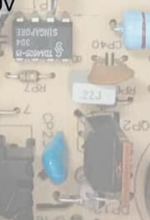 | |
Posted by: stansteph54 on 2022-10-13 09:06:14You should better open a new post...Thanks a lot spending time to help me. Very much appreciated. I don't know how to copy/paste in a new post, maybe a moderator will do for us ? So, I've just found a CR-44 schematics but seems this is not exactly the same...at least components haven't the same names :-( https://museo.freaknet.org/gallery/apple/stuff/mac/andreas.kann/SE_Netzteil.GIF In the meantime I recapped the 2 missing capacitors of the recommendation picture below. I've checked voltage out of the diode bridge : 315V DC Still absolutely nothing happen when I switch power on... I haven't recapped the 2 big 220uF/400V next to the power switch. What IC do you mean ? the 8 pins TDA ? What is the mosfet close to it ? sorry I'm a newbie but with a true strong wish to learn! And I promise to be a good student. In order to start, I looked for datasheets : IP1 is TDA 4605 : https://pdf1.alldatasheet.fr/datasheet-pdf/view/25064/STMICROELECTRONICS/TDA4605.html QP2 is MTP 6N60 : https://pdf1.alldatasheet.fr/datasheet-pdf/view/23383/STMICROELECTRONICS/MTP6N60.html if so How can I check them ? Thanks a lot again 😍 Stéphane | |
| Posted by: stansteph54 on 2022-10-13 12:59:04 Hi again, In the meantime I've checked supply voltage between pin4 and pin6 of the TDA4605 and found about 11,15V DC which I think is correct ? Thanks again for your kind help | |
| Posted by: 3lectr1cPPC on 2022-10-13 15:10:52 11.15 is low, it should be 12v. Could just have to be adjusted but with how unreliable these boards are it could be another failed part. | |
Posted by: bibilit on 2022-10-13 23:10:35TDA4605 and found about 11,15V DC which I think is correct ? IIRC this is AC and not DC. 11.15 is low... probably the usual suspects, DP4 and DP3 (1N4148 diodes) are leaky and to be replaced, but all in all 11 volts is the minimum required for switch-on voltage. | |
Posted by: stansteph54 on 2022-10-14 01:49:02IIRC this is AC and not DC. 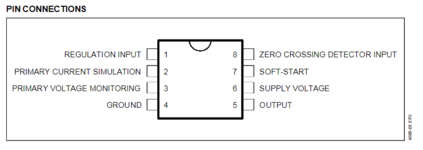 Hi bibilit, Voltage between pin4/ground and 6/supply voltage is AC ? and not DC? thanks Hi bibilit, Voltage between pin4/ground and 6/supply voltage is AC ? and not DC? thanks | |
| Posted by: bibilit on 2022-10-14 02:32:11 Yes AC not DC as this part is on the primary side (4) is ground and (6) 12 volt AC pin (5) goes to the Mosfet (QP2 / IRFEC 40) If the Mosfet is gone, the fuse will blow probably. Also worth checking the Optocoupler QP1 (CNY 17) But replace the two diodes first, by far the cheapest units and to be replaced as a matter of fact, most not working units are due to those two diodes (not shorted, simply leaking) | |
| Posted by: mikes-macs on 2022-10-14 05:11:32 Copy and paste have been around for ages now. I remember when Drag and Drops came out. Sounded like Dragon drops. | |
Posted by: stansteph54 on 2022-10-15 02:47:46Yes AC not DC as this part is on the primary sideSo I've rechecked and between pin 4 and pin 6 I've almost NOTHING AC !! but only 11,2V DC ! maybe it could help to diagnostic even I cannot understand we are AC on this side after the diode bridge (newbie I am!) Besides, * how could I check QP1 optocoupler ? I have an oscilloscope if needed. * what are the 2 diodes I need to replace ? With 68000 thanks again, Stéphane | |
| 1 > |