68kMLA Classic Interface
This is a version of the 68kMLA forums for viewing on your favorite old mac. Visitors on modern platforms may prefer the main site.
| Click here to select a new forum. | |
| Unusual "Memory Plus" SE/30 video card | |
| Posted by: cheesestraws on 2021-08-17 14:17:07 I ended up with one of these in an SE/30. Obviously a video card, but what mysteries does it contain? Anyone got any context? :-D It is particularly annoying/intriguing that the identifiers have been sanded off the big ICs. 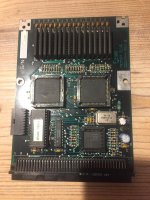 Looking for this card elsewhere, I found only two mentions of it online at all (though I may be missing something). Someone here had one with the board marked the same but with the ROM marked differently: Macintosh SE Accelerator PDS Add-on CardsHi Everyone I have two add-on cards for the Macintosh SE and/or SE/30 that I hope to get a bit of help identifying. I had confirmed they worked when I removed them from the original machines a long time ago but I did not record the information and I no longer have a machine to use at this...
 68kmla.org
Someone over here had one with a ROM marked the same as mine, but details seem to be lacking beyond "it works": Unbekannte Karte für Mac SE/30Hallo Community, ich habe in einem alten Mac SE/30 folgende Karte gefunden, die ich nicht richtig einordnen kann. Hat einer eine Idee, um was für eine Karte es sich hierbei handeln könnte? :confused: Die Karte passt auf einen SE/30-PDS Steckplatz. Der Stecker nach außen sieht nach einem...
So, does anyone know what the specs of this card are, why it exists, when it existed, who made it? | |
| Posted by: demik on 2021-08-17 16:21:54 The quartz is 30.24 MHz, which is the pixel clock frequency for 640x480 @ 67 Hz/ It looks like it has enough VRAM for 16 bit colors, although given the fabrication date that may be only 8 bits. | |
| Posted by: cheesestraws on 2021-08-18 06:59:06 The VRAM chips are 64kword x 4, so in terms of pure bits 32kbyte per chip; there are 16 of them so I have 512kbyte of VRAM there. Which will only do 640x480x8. Could do 512x384x16 in theory... | |
| Posted by: mikes-macs on 2021-08-26 08:33:12 I have one of these in my SE/30. 640x480 256. Works well with Mac OS 7.5-8.1. I have not found software for it so I'm using it with standard Mac video drivers. 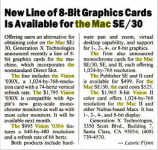 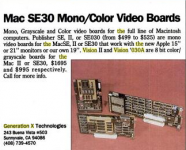 | |
Posted by: cheesestraws on 2021-09-07 07:55:22I have one of these in my SE/30. 640x480 256. Works well with Mac OS 7.5-8.1. Thanks! I still haven't given this one a try but this info is useful. Attached to this post is the ROM, in case anyone wants/needs it (I know @demik wanted a copy) | |
Posted by: demik on 2021-09-07 09:42:47I have one of these in my SE/30. 640x480 256. Works well with Mac OS 7.5-8.1. Do you have any picture of yours by any chance ? We are trying to figure what the sanded chips are. | |
| Posted by: cheesestraws on 2021-09-07 10:49:05 I should have said that that ROM image lives on a 27C64 | |
| Posted by: trag on 2021-09-07 11:25:31 I would guess the big 84 pin PLCCs are Xilinx 3030s or similar, except, I don't see any storage device to hold their bitstream. There's the EPROM there, but it's holding the Mac card thingy. I don't think it can do both. | |
| Posted by: bdurbrow on 2021-09-07 11:30:54 Non-volatile CPLDs perhaps? | |
Posted by: Bolle on 2021-09-07 11:47:00I don't think it can do both.It can do both. It is that way on a few Radius cards. It’s not the case here though, so the two ICs aren’t 2018/64s or 3000 series FPGAs. There are no Xilinx bitstreams inside the ROM dump. They could be non volatile CPLDs - I think I have seen Altera ones on gear from that timespan. Not sure if AMD MACHs did exist in that size. Checking GND and VCC pins against a few different CPLD datasheets might give us a hint. | |
Posted by: trag on 2021-09-07 15:55:18It can do both. It is that way on a few Radius cards.Wow! What do they do? Play with the address lines to the EPROM so that different clients access different segments? I guess if the FPGAs drive an OE or CE signal, one could tie it to one or more address pins on the storage device, maybe. | |
| Posted by: mikes-macs on 2021-09-17 23:11:58 Sorry for the delay. Here's mine for what it's worth. 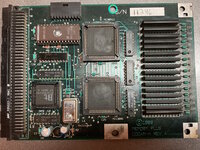 | |
Posted by: cheesestraws on 2021-09-18 01:46:05Sorry for the delay. Here's mine for what it's worth. If that's working now you might want to stick a label or something over the window in that EPROM, or at least not leave it out or in sunlight... (if you know that already and it's deliberate please ignore me but that would be a really annoying way for a card to break) They really are determined that people not know what those chips are, aren't they. Hrm. | |
Posted by: mikes-macs on 2021-09-18 12:56:58you might want to stick a label or something over the window in that EPROM.Thanks for the tip. I don't know anything about circuits or chips. It's why I come here, to learn from you all. I happened to pick this up inside a Mac SE/30 a few years ago and it works. I did a bit of research on it but never found the software that shipped with it. I'll cover it as you suggested although I'm no sure why so if you feel like explaining why you need to cover it it would be appreciated. I suppose I could look it up. I'm assuming sunlight damages it. I'm guessing the info you need was intentionally sanded off on those two square black dies inside those sockets. Noticed mine is Rev A. and there is a trace added by someone. | |
Posted by: cheesestraws on 2021-09-18 13:44:08although I'm no sure why so if you feel like explaining why you need to cover it it would be appreciated Oh, sorry, I should have said. Those chips, the ones with the window, are UV-erased EPROMs. So they can be programmed and reprogrammed multiple times, and the way you erase them between programming is UV light. That's why the window is there, so the light can get in and erase the chip. So if you don't want to erase the chip, it's best to stick a label or something over the little window: sunlight certainly is strong enough to partially erase the chip, then your video card won't work any more. | |
| Posted by: mikes-macs on 2021-09-19 01:10:50 Thanks for the info. I won't be offended if you happen to tell me something I already know. In this case I didn't know it and you probably saved the card for me. I'm using my video card now in my SE/30 with 64 MB RAM and Rominator II. It's nice having color on a second screen but I think my Mac IIsi builti-in video is slightly sharper. Especially since using IIsi RAM-Muncher. The screen seems quicker and crisper on the same monitor. Nevertheless the SE/30 seems happy and it plays color games. I'm posting what TattleTech 2.5.8 says about it. • Display# = 2 ◊ Active = Yes ◊ Main Screen = Yes ◊ Color Device = Yes ◊ Type = CLUT Device ◊ Driver# = -51 ◊ Screen Size = 640 X 480 Pixels ◊ Resolution = 72.0 X 72.0 Pixels/Inch ◊ Pixel Depth = 8 (256 Colors) ◊ Max Pixel Depth (Installed Memory) = 8 (256 Colors) + Mem Req for This Depth = 307,200 Bytes (0.3 MB) ◊ Mem Req for 24 Bit (Millions) = 1,228,800 Bytes (1.2 MB) • Nubus/PDS Slot# = $0B ◊ Board Name = Generation X V/30A ◊ Board ID = 548 ◊ Vendor ID = Generation X ◊ Revision Level = Alpha 1.0 ◊ Part# = V/30A ◊ Functional Resources : + Device sResource Name = Color_Virtual_Display - Device Category = 3 (Display) - Device Type = 1 (Video) - Device Software Interface Type = 1 - Device Hardware Type = 1 - Device sResource# = $80 - Driver Number = -51 ---------------------------------- • Nubus/PDS Slot# = $0E | |
Posted by: crosswindpm on 2024-01-27 15:43:40Do you have any picture of yours by any chance ? We are trying to figure what the sanded chips are.The sanded chips are Xilinx FPGA chips. I used to run the service department for the company behind memory plus. That is an SE-30 color board . The brook tree chip deals with color processing and the thin chips were the VRAM for it. | |
Posted by: cheesestraws on 2024-01-27 15:53:01The sanded chips are Xilinx FPGA chips. I used to run the service department for the company behind memory plus. That is an SE-30 color board . The brook tree chip deals with color processing and the thin chips were the VRAM for it. Oh, cool! Thanks for the information about the FPGAs. Much appreciated 🙂 | |
Posted by: Phipli on 2024-01-27 15:59:57The sanded chips are Xilinx FPGA chips. I used to run the service department for the company behind memory plus. That is an SE-30 color board . The brook tree chip deals with color processing and the thin chips were the VRAM for it.Thanks for posting. Was there any supporting software that extended the functionality? Do you still run any vintage macs these days? | |
Posted by: chris98vf on 2024-03-28 09:53:00The sanded chips are Xilinx FPGA chips. I used to run the service department for the company behind memory plus. That is an SE-30 color board . The brook tree chip deals with color processing and the thin chips were the VRAM for it.I have a memory plus card I'm trying to get working. Any chance you could shed some light on it for me? Need to know if it's VGA/CGA/TTL or whatever combination of 3 letters it might be to get it working. Thanks! | |
| 1 > |